
XPOWER Water Damage Restoration in Los Angeles: A Homeowner’s Guide
A $150 XPOWER air mover rental from Home Depot looks nearly identical to the professional unit a restoration company rolls into your living room. The difference isn’t the machine. It’s the airflow calculation that tells a technician where to point it, how many to deploy, and when to move them. Get that math wrong and you’re not drying your Los Angeles home. You’re just moving humid air around while mold gets comfortable inside your drywall.
If you’re standing in a wet house right now and don’t want to become a psychrometrics expert by tonight, call us at (940) 466-4354. We’ll send a technician with a live arrival time you can track, and you’ll get a written price before any work starts. If you want to understand what XPOWER equipment actually does and where rentals go wrong, keep reading.
What XPOWER Equipment Actually Does (and What It Can’t)
XPOWER makes professional air movers, dehumidifiers, and air scrubbers. The brand shows up in two places: the rental aisle at big-box stores and the truck of a certified restoration company. Same logo. Very different outcomes.
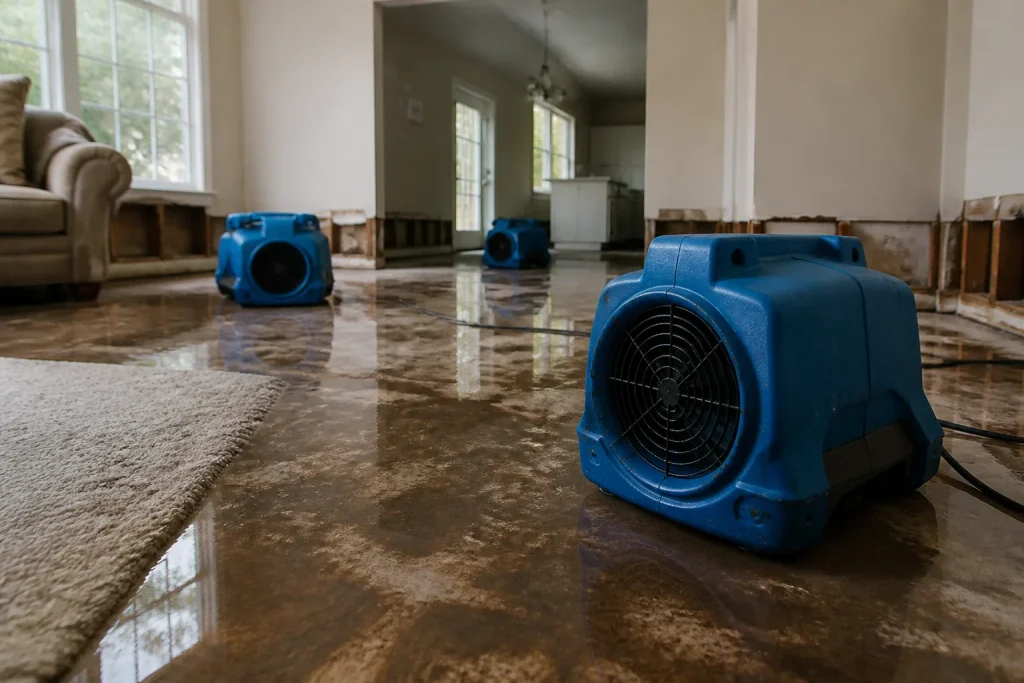
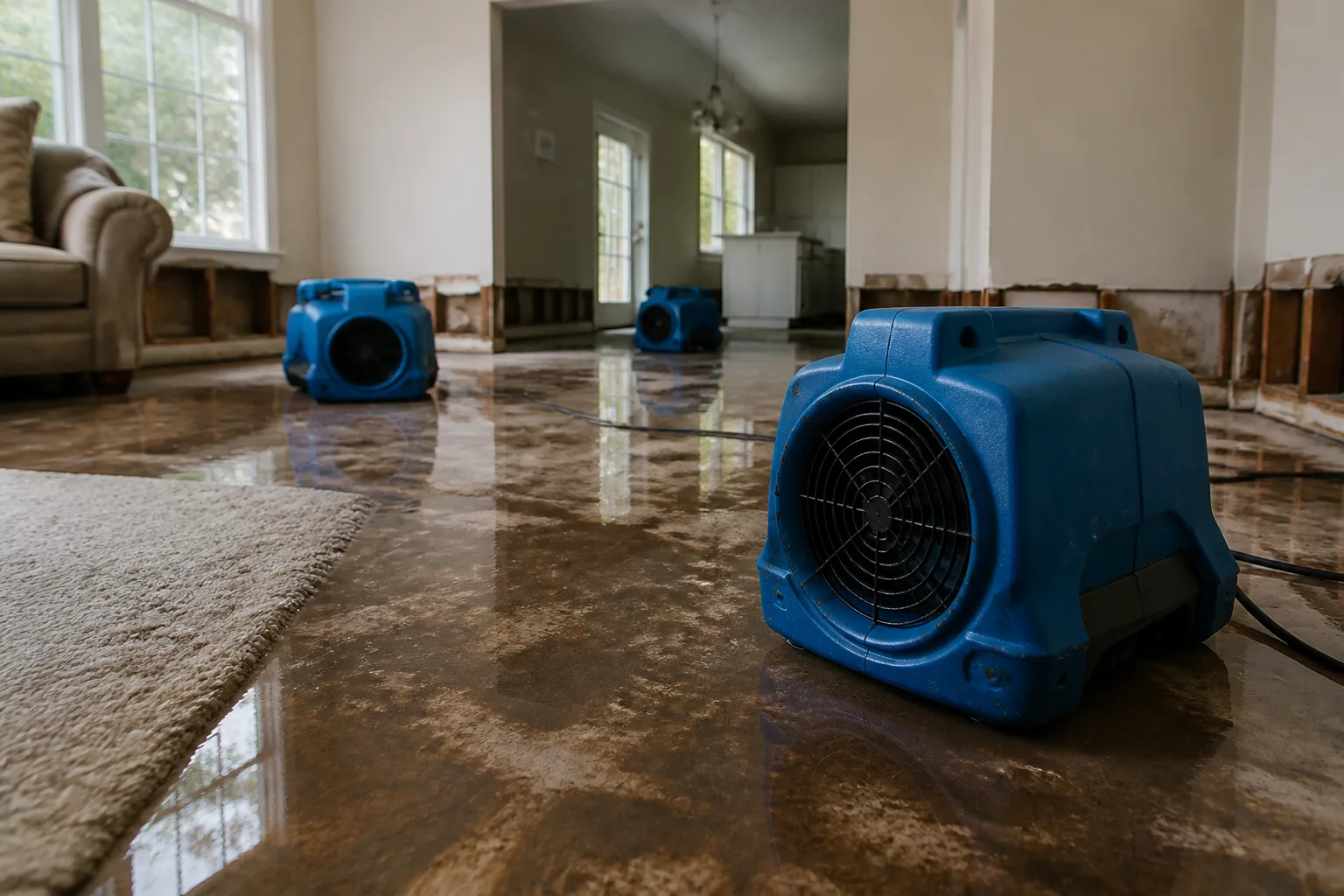
An air mover like the XPOWER X-830H is essentially a high-velocity fan engineered to force air across wet surfaces. That airflow does one thing: it accelerates evaporation at the surface level. Water in your carpet pad, behind your baseboards, or trapped in your drywall turns into vapor faster when air moves over it quickly. That sounds simple, and it is. The catch is that evaporation alone doesn’t remove moisture from your home. It just relocates it from your floor into your air. If nobody pulls that moisture out of the air, it condenses somewhere else, often inside wall cavities or on cooler surfaces. The structure stays wet. What changes is where the water hides.
A dehumidifier is what actually removes moisture from the air. Professional restoration companies pair XPOWER air movers with dehumidifiers sized to the room’s cubic footage and the category of water involved. Rentals rarely include the right dehumidifier, or they include one that’s undersized for the actual water load. We’ve walked into Los Angeles homes where a homeowner ran three rental air movers for a week with no dehumidifier at all. The floor felt dry to the touch. The moisture meter told a different story, and by then the baseboards had started swelling.
Equipment Class Matters: Why the XPOWER Model in the Truck Is Different
Not all XPOWER units are built for the same job. The X-830H is a lightweight, compact air mover that works well for surface drying in smaller spaces. The X-47ATR is a larger axial air mover with significantly more airflow, designed for professional restorative drying. Then there are the low-profile models that slide under cabinets. A restoration company selects equipment class based on the category of water intrusion, the affected square footage, and the materials involved.
Category 2 water, often called gray water, comes from sources like washing machine overflows or dishwasher leaks. It carries some contaminants. Category 3 water, or black water, comes from sewage backups or floodwater from outside. It’s loaded with bacteria and pathogens, and the drying protocol is completely different. Category 3 jobs in Los Angeles typically require removing and disposing of affected porous materials, not just drying them. An XPOWER air mover can’t sanitize a sewage-saturated carpet pad. That material has to come out.
Rental equipment doesn’t tell you any of this. A technician certified under IICRC standards does. The certification matters because it means the person holding the moisture meter understands how to read the numbers, adjust equipment placement, and document the drying curve with daily psychrometric readings. Ask any contractor you’re considering: “What category water is this, and which XPOWER class will you deploy?” If they look confused, call someone else.
Why Los Angeles Humidity Changes the Drying Equation
Los Angeles isn’t one climate. It’s a collection of microclimates, and your ZIP code changes how long XPOWER equipment has to run. Coastal neighborhoods like Venice, Santa Monica, and Playa del Rey sit in marine air with ambient relative humidity that regularly hangs above 70 percent, especially overnight and during May Gray and June Gloom. High ambient humidity means the air already holds a lot of moisture, which slows evaporation. A drying job in Venice can take 20 to 30 percent longer than the same job in Burbank or Pasadena, where the air is measurably drier.
This is where psychrometric data stops being jargon and starts being the entire ballgame. A technician taking daily readings tracks three numbers: relative humidity, specific humidity, and temperature. Those readings tell us whether the drying environment is actually working. If humidity inside the affected space isn’t dropping day over day, we know to adjust equipment placement, add dehumidification capacity, or seal off the area more tightly. The equipment can be perfect, but if the environment isn’t being managed, the structure isn’t drying.
This is also why Los Angeles homeowners should be skeptical of anyone who gives a fixed number of days for drying before seeing the job. A Venice bathroom with Category 2 water in February dries on a different timeline than a Pasadena hallway in October. Anyone who promises “three days, guaranteed” without evaluating the room, the water category, and the ambient humidity is guessing.
Psychrometric Logging: The Step Rentals Skip and Cheap Contractors Fake
Psychrometric logging is the daily practice of recording moisture readings from the structure and the air, then graphing those numbers to confirm a downward drying trend. A certified technician sets baseline readings on day one. Every subsequent day, they return to the same points, take new readings, and reposition XPOWER units based on what the data shows. The goal is a drying curve that trends consistently toward the dry standard for that material, not just a floor that feels dry on top.
Skipping this step wastes days and money. Homeowners who rent equipment and run it without monitoring typically end up with two problems. First, the visible surface dries while the hidden cavity stays wet. Second, they pay for equipment rental for the full period even though the job took twice as long as it should have because nobody adjusted anything. We’ve seen rental bills hit $600 or more by the time a homeowner realizes the job wasn’t actually done. That money would have covered a significant portion of professional restoration with daily monitoring included.
When you’re interviewing restoration companies in Los Angeles, ask two specific questions. “Are you pulling daily psychrometric reports?” and “Will I receive those readings in writing?” A legitimate company answers yes to both without hesitation. At Wendell Water Damage Restoration, every job includes written documentation of moisture readings from start to finish, because the number you should care about isn’t how the floor feels. It’s what the meter says, on paper, with a date on it.
What to Ask Before Anyone Runs an XPOWER Unit in Your Home
Here’s the practical checklist we’d give a friend in Los Angeles who just found water damage and is weighing a rental against hiring a professional.
- What category is the water, and how does that change the drying plan? Category 2 and Category 3 require different equipment classes and different safety protocols. Get the answer in writing.
- How many air movers will you deploy, and where will you place them? Placement is based on cubic feet per minute calculations tied to room size. A vague “we’ll figure it out” won’t cut it.
- Will you match dehumidifier capacity to the water load? Air movers without the right dehumidifier just move moisture around. Get the pints-per-day rating and the square footage it’s sized for.
- Are you certified under IICRC, RIA, or IFA standards? Certifications signal that the person holding the meter knows how to read it. It’s the single best proxy for competence you have as a homeowner.
- Will I get daily moisture readings in writing? If they won’t commit to written documentation, they’re probably not documenting anything.
- What does the drying plan cost, and what happens if my structure isn’t dry when the estimate says it will be? At Wendell, every job comes with a written price before work begins and a Done Right Promise: if it’s not done right, we make it right. In writing, on every single repair.
We once pulled a dehumidifier out of a garage in Echo Park where the homeowner had rented two XPOWER air movers and run them pointed directly at the same spot for nine days. The floor was dry in that one spot. The wall behind it read 38 percent moisture content, which is about 30 points above the dry standard for drywall. The renter spent more on nine days of equipment than a professional would have charged to dry the whole room properly, with daily readings proving it was done.
When to Call a Pro (and When a Rental Might Actually Work)
A rental air mover can handle a truly minor surface issue: a small spill on a concrete floor, a single wet mat in a garage, a spot where water pooled but never wicked into porous materials. If the water involved was clean, the area is under 20 square feet, and you can verify with a $25 moisture meter that the underlying material is dry, a rental might be fine.
But if the water touched drywall, went under flooring, came up from a drain, or sat for more than a few hours, you’re past the rental zone. That’s when you need a professional with commercial equipment brands like Dri-Eaz, Phoenix, XPOWER, B-Air, and Injectidry, deployed under IICRC, RIA, and IFA standards. Those are the same certifications and equipment brands used on large commercial loss sites, and for good reason. Water damage in Los Angeles doesn’t wait politely. It wicks upward through drywall, saturates insulation, and starts growing mold in as little as 48 hours in the city’s warmer inland neighborhoods.
If you’re in Los Angeles and need a professional assessment, we cover Water Damage Restoration in Los Angeles, along with Water Damage Repair in Los Angeles and Mold Remediation in Los Angeles. Every job starts with a written price before any tools leave the truck, plus background-checked, uniformed technicians who show up with a live arrival time you can track, not a four-hour window.
The Bottom Line
XPOWER equipment is excellent, but it’s a tool, not a solution. An air mover only works when a trained technician calculates the airflow, matches it with the right dehumidifier, accounts for Los Angeles’s microclimate, and verifies the drying curve with daily psychrometric readings. Rentals skip every one of those steps, and homeowners end up paying twice: once for the rental, once for the damage that happened while they thought they were drying.
The smart move is to ask better questions before anyone sets up a fan in your home. Ask about water category, equipment class plans, and written moisture documentation. A company that answers clearly and in writing is a company worth trusting. If you’re in Los Angeles and need help, Wendell Water Damage Restoration offers free estimates. Call (940) 466-4354 and a live person answers. Not a voicemail, not a callback queue. A person. We’ll put your price in writing before any work starts, and you’ll get before-and-after photo updates by text so you can see exactly what was done.
Frequently Asked Questions
No. The equipment may share a brand name, but professional restoration pairs XPOWER air movers with properly sized dehumidifiers and daily psychrometric monitoring. A rental gives you a fan. A restoration company gives you a measured, documented drying plan. If you’re in Los Angeles and want a written price before any work starts, call (940) 466-4354.
Most residential drying jobs in Los Angeles take three to seven days, but coastal areas like Venice and Santa Monica run longer due to higher ambient humidity. Anyone who gives you a fixed number of days before evaluating the room, the water category, and the microclimate is guessing. Daily moisture readings are the only reliable way to know when a structure is actually dry.
No. Air movers accelerate evaporation, but a dehumidifier is what actually removes moisture from the air. Without one, the water vapor condenses elsewhere in the structure, often inside walls and under flooring. You’ll have a dry floor and a growing mold problem.
Ask what water category you’re dealing with, how many air movers they’ll deploy and where, what dehumidifier capacity they’re bringing, whether they’re certified under IICRC standards, and whether you’ll receive daily psychrometric readings in writing. If they hesitate on any of these, get another quote.
Written by the team at Wendell Water Damage Restoration.
Need Damage Restoration Help?
Call Wendell Water Damage Restoration - licensed & insured, here with fast after-hours help in Los Angeles.
(940) 466-4354