
IFA Water Damage Restoration in Los Angeles: A Homeowner’s Guide
IFA water damage restoration refers to the Institute of Inspection, Cleaning and Restoration Certification’s (IICRC) Inspection, Forensic, and Assessment standards that govern how restoration contractors evaluate, document, and dry water-damaged properties. In plain terms, it’s the professional playbook for proving your home is actually dry. If you’re staring at an invoice full of IFA codes and equipment line items, here’s the short version: you should know what every charge means before you pay it. And if you’d rather not decode this alone, call (940) 466-4354 and we’ll walk you through it.
Most homeowners in Los Angeles don’t realize that restoration invoices are written in a language designed by insurance adjusters and equipment manufacturers, not by people who want you to understand what happened. That confusion isn’t accidental. Companies count on you not asking questions. This guide exists so you can ask better ones.
Key Takeaways
- IFA standards govern how moisture is measured, documented, and dried, not just what equipment gets plugged in.
- Psychrometric calculations (tracking air temperature, humidity, and vapor pressure) determine how long drying actually takes in your specific rooms.
- Equipment placement matters more than equipment count. A dehumidifier in the wrong corner adds days to your timeline.
- Daily moisture logs should be provided in writing or by text. If a company won’t share them, that’s a red flag.
- The most common billing inflation is leaving dehumidifiers running after drying targets are met and charging you for the extra days.
What IFA Actually Means When It Shows Up on Your Bill
IFA is not a product. It’s not a machine. It’s a set of assessment and forensic standards under the broader IICRC umbrella that dictate how a restoration contractor verifies water damage, documents the initial condition, establishes drying goals, and confirms those goals were reached. The average Los Angeles homeowner sees “IFA” in a work order and assumes it’s some upgrade they’re paying extra for. It isn’t. It’s the baseline for doing the job correctly.
Here’s what IFA standards require on a typical Los Angeles water damage job: a room-by-room moisture map taken before any equipment goes in, daily readings that show moisture levels trending downward, and a final reading that confirms structural materials have returned to their dry standard. The dry standard isn’t a guess. It’s calculated using psychrometrics, which means measuring the relationship between air temperature, relative humidity, and the vapor pressure in your walls and floors. A technician doing this right can tell you, room by room, how many days drying should take. A technician skipping this step is guessing, and you’re paying for the guess.
We’ve walked into homes in Silver Lake and Echo Park where a previous company left equipment running for eleven days with no moisture log at all. The homeowner paid for eleven days of drying. The walls were dry by day four. That’s what IFA standards are designed to prevent.
The Psychrometric Part Nobody Explains
Psychrometrics sounds like a college course you didn’t sign up for, but it’s just the science of how water moves from wet materials into the air. Warm air holds more moisture than cold air. Moving air picks up moisture faster than still air. Dehumidifiers pull moisture out of the air so it can keep absorbing more from your walls and floors. That’s the entire drying equation.
What changes from house to house in Los Angeles is the starting point. A 1920s bungalow in Highland Park with plaster walls and no insulation dries differently than a 2018 condo in Playa Vista with drywall and closed-cell insulation. A room that already had high relative humidity before a pipe burst in the wall needs a different dehumidifier placement than a room that stays naturally dry. That’s why the technician’s first job is a thorough psychrometric assessment, not plugging in fans and hoping.
Ask your restoration contractor two questions on day one: What is the dry standard for this room, and what daily reading are you expecting to see by day three? If they can’t answer both, they’re not running an IFA-standard job, regardless of what the invoice says.
Equipment Placement Is the Difference Between Three Days and Seven
You can rent the same Dri-Eaz dehumidifier a commercial crew uses, park it in the middle of a flooded room, and still end up with mold in the baseboards. That’s because drying is directional. Air has to travel across the wet surface, pick up moisture, and carry it to the dehumidifier’s intake. If the equipment isn’t arranged to create that airflow, it’s just running up your electric bill.
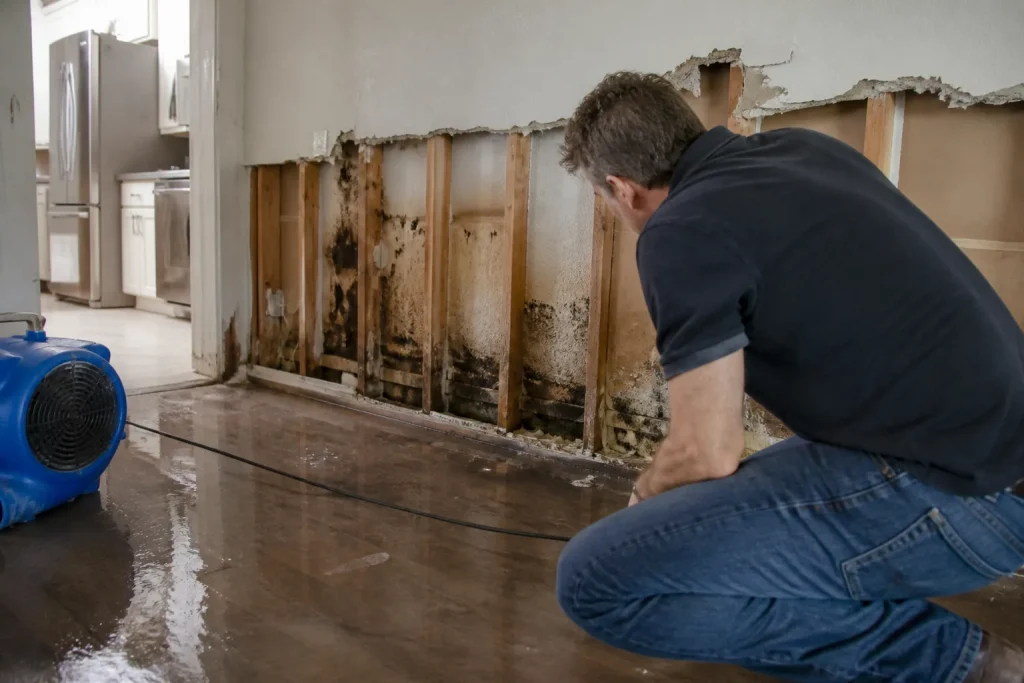
A properly placed drying system in a Los Angeles living room looks like this: an air mover aimed at the wet wall cavity, not the middle of the floor; a dehumidifier positioned to capture the moist air being pushed out of the room; and a second air mover pointed at the corner where two wet walls meet, because corners trap moisture. We use equipment from Dri-Eaz, Phoenix, and XPOWER, but the brand doesn’t matter if the placement is wrong. The placement plan is the actual work.
Before the crew leaves on day one, ask them to explain their placement plan. Not to justify it with jargon, but to actually explain it: “This air mover is aimed at the wet baseboard here because…” A technician who can explain the plan understands the job. A technician who says “this is just how we do it” is running a template, not your specific drying project.
Your Monitoring Log: What It Should Look Like and Why You Should Get It Daily
Every IFA-standard restoration job includes a monitoring log. This is a written record of daily moisture readings taken from specific spots in your walls, floors, and baseboards. The numbers should decline every day. Some days they’ll drop a lot, some days a little, but they should never plateau for three days running while the equipment stays on. A plateau means either the equipment isn’t doing its job or the drying target has already been reached and someone’s stretching the timeline.
The readings are usually measured in moisture content percentage for wood and drywall, or in a relative scale for concrete and tile. You don’t need to understand the science behind the numbers. You need to see the numbers. We send before-and-after photos by text and provide daily moisture readings in writing, because the log is the proof that work actually happened. Without it, you’re taking someone’s word that the walls are dry enough for the repair to begin.
If a Los Angeles restoration company refuses to provide daily readings or says they’ll “send everything at the end,” that’s a billing accident waiting to happen. You can’t dispute charges for days you can’t verify.
Where Invoices Get Padded and How to Spot It
The most common billing inflation in water damage restoration isn’t phantom equipment or made-up disposal fees. It’s runtime. Companies leave dehumidifiers and air movers running after the drying targets have been met and bill you for every extra day. The equipment is already on site, so the marginal cost to them is minimal. The charge to you is pure profit.
Here’s what to look for on your invoice:
- Equipment line items that show daily rental with no end date matching your moisture log’s final reading.
- Dehumidifier charges continuing past the date your walls tested at dry standard.
- Air mover counts that don’t match the placement plan you saw on day one.
- Multiple “monitoring visits” charged beyond the day the job should have been completed.
Before any work starts at your Los Angeles property, get the price in writing. Not an estimate with a range, but the actual price you’ll pay. Wendell puts the price in writing before any tools come off the truck, and you get a digital invoice texted to your phone so the number on the screen is the number you pay. That’s how you prevent runtime padding before it starts. We also include a Done Right Promise on every repair, which means if it’s not done right, we make it right. In writing. On every single job.
When to Call a Pro
Water damage in Los Angeles doesn’t wait for business hours. A slow leak behind a kitchen cabinet in Santa Monica becomes a mold problem in days, not weeks. A burst pipe in a Koreatown apartment building stairwell becomes a structural issue and a liability issue overnight. If you see standing water that covers more than a few square feet, water wicking up drywall, or water that’s been sitting for more than 24 hours, call a professional. The drying window is closing, and every hour adds to the final cost.
We answer every call with a live person, 24/7, because water damage doesn’t keep business hours and neither do we. You’ll get a written price before any work starts, background-checked uniformed technicians with a live arrival time you can track, and before-and-after photo updates by text so you can see the drying milestones hit your home, room by room. Most restoration companies in Los Angeles won’t do any of that.
Related services in Los Angeles: Water Damage Restoration in Los Angeles, Mold Remediation in Los Angeles, and Water Damage Repair in Los Angeles. If you’re not sure which one applies to your situation, call and ask. We’ll tell you straight.
The Bottom Line
IFA water damage restoration in Los Angeles isn’t a special upgrade. It’s the standard for verifying that your home is properly dried, documented, and ready for repair. The companies that do it right will show you their moisture readings, explain their equipment placement, and put their price in writing before work begins. The companies that don’t are counting on you not asking.
At Wendell Water Damage Restoration home, we built our entire process around the questions homeowners should be asking. Founded in 2006 and part of the Relay Home Co. family, we run every Los Angeles job to IICRC, RIA, and IFA standards using professional equipment from Dri-Eaz, Phoenix, XPOWER, B-Air, and Injectidry. Every job includes three non-negotiables: a written price before any work starts, a written guarantee on every repair, and a free second visit if the repair fails. If you’re dealing with water damage in Los Angeles and want someone who answers the phone and tells you the truth, call (940) 466-4354 for a free estimate.
Frequently Asked Questions
IFA stands for Inspection, Forensic, and Assessment, which are the IICRC standards that govern how restoration contractors evaluate, document, and verify water damage drying. It’s the professional protocol for proving your home is actually dry, not just surface-dry.
Most water damage restoration jobs in Los Angeles run between $1,500 and $4,500 for a typical single-room drying project, with larger multi-room jobs ranging from $5,000 to $15,000. The exact price depends on the affected square footage, how long the water has been sitting, and the drying goals set by psychrometric calculations. Call (940) 466-4354 for an exact quote on your property, estimates are free and always in writing.
A properly managed drying project in Los Angeles typically takes three to seven days, with most single-room jobs hitting dry standard by day four or five. The timeline depends on your home’s materials, the humidity level in your rooms, and whether the equipment was placed correctly from day one.
Most Los Angeles homeowners policies cover water damage restoration when the cause is sudden and accidental, like a burst pipe or an appliance failure. Coverage for gradual leaks varies by insurer and specific policy. We document every job with photos and moisture readings that help you work directly with your adjuster, and we’ll coordinate with them so you don’t have to translate the invoice.
Written by the team at Wendell Water Damage Restoration.
Need Damage Restoration Help?
Call Wendell Water Damage Restoration - licensed & insured, here with fast after-hours help in Los Angeles.
(940) 466-4354