
5 Mistakes to Avoid With Water Damage Repair
Most water damage repair mistakes don’t look like mistakes at the time. They look like reasonable, even helpful decisions: running a fan, waiting a day to see if things dry on their own, accepting a quick verbal quote. The five costliest errors we see in Los Angeles homes are small process decisions made in the first 24 hours that compound into mold claims, structural repairs, and insurance fights weeks later. Here’s what to avoid and what to do instead. If you’d rather skip the reading and talk to someone now, call (940) 466-4354 and we’ll walk you through it.
Mistake 1: Running the HVAC Before You Know the Water Category
Turning on your HVAC after a flood feels like common sense. Move the air, dry the place out. It’s actually one of the fastest ways to distribute mold spores and bacteria from the affected area into every room in the house. Here’s why: restoration professionals classify water into three categories before touching a single fan.
- Category 1 (clean water) comes from a supply line, a faucet, or a broken pipe. It’s sanitary at the source.
- Category 2 (gray water) is contaminated. Think washing machine discharge, dishwasher overflow, or toilet water without solid waste. It carries bacteria and nutrients that feed microbial growth.
- Category 3 (black water) is sewage, floodwater from outside, or any water that has sat long enough to grow pathogens. This water is hazardous.
When you run the HVAC during a Category 2 or Category 3 event, the blower pulls contaminated air from the wet area and pushes it through every vent in the home. Within hours, you’ve cross-contaminated bedrooms, closets, and hallways that were never wet. Now your mitigation job just became a whole-structure decontamination, and your insurance claim just got more complicated because the spread is technically from the HVAC, not the original water event. If there’s any chance the water is gray or black, leave the HVAC off until a restoration tech confirms the category and isolates the affected zone with containment barriers and negative air pressure. In Los Angeles, where many homes have central air running year-round, this is the single most common mistake we’re called to correct.
Mistake 2: Waiting Until the Visible Water Is Gone to Call
Here’s what we hear on the phone: “The water wasn’t that deep, so we mopped it up. We figured if it looked dry by morning, we’d be fine.” The problem is that visible water is maybe 20% of the actual water. The rest has already moved.
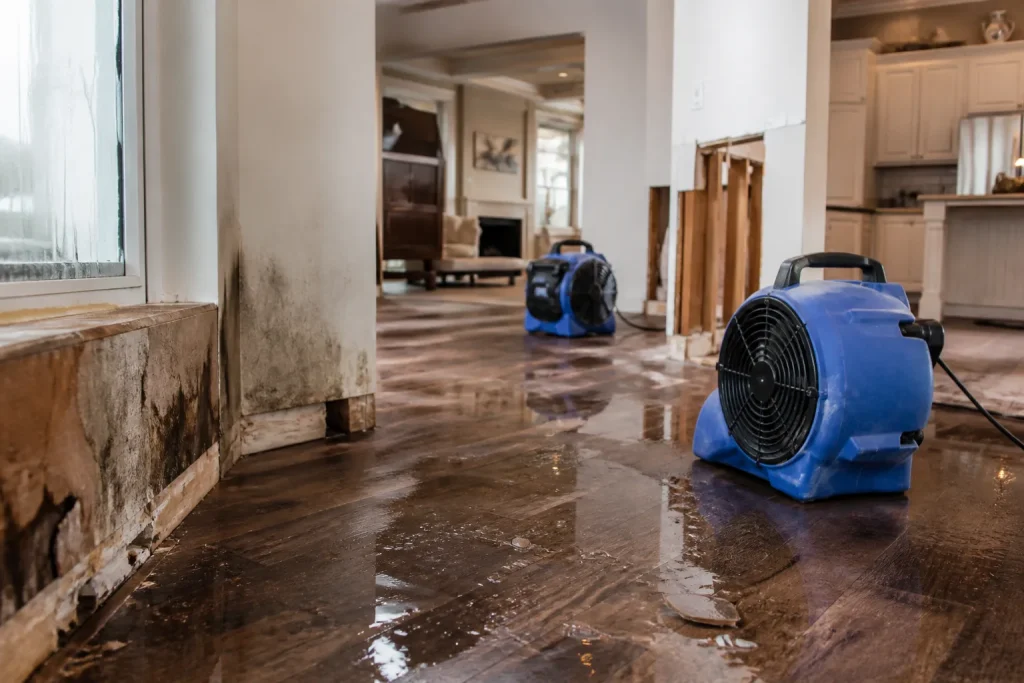
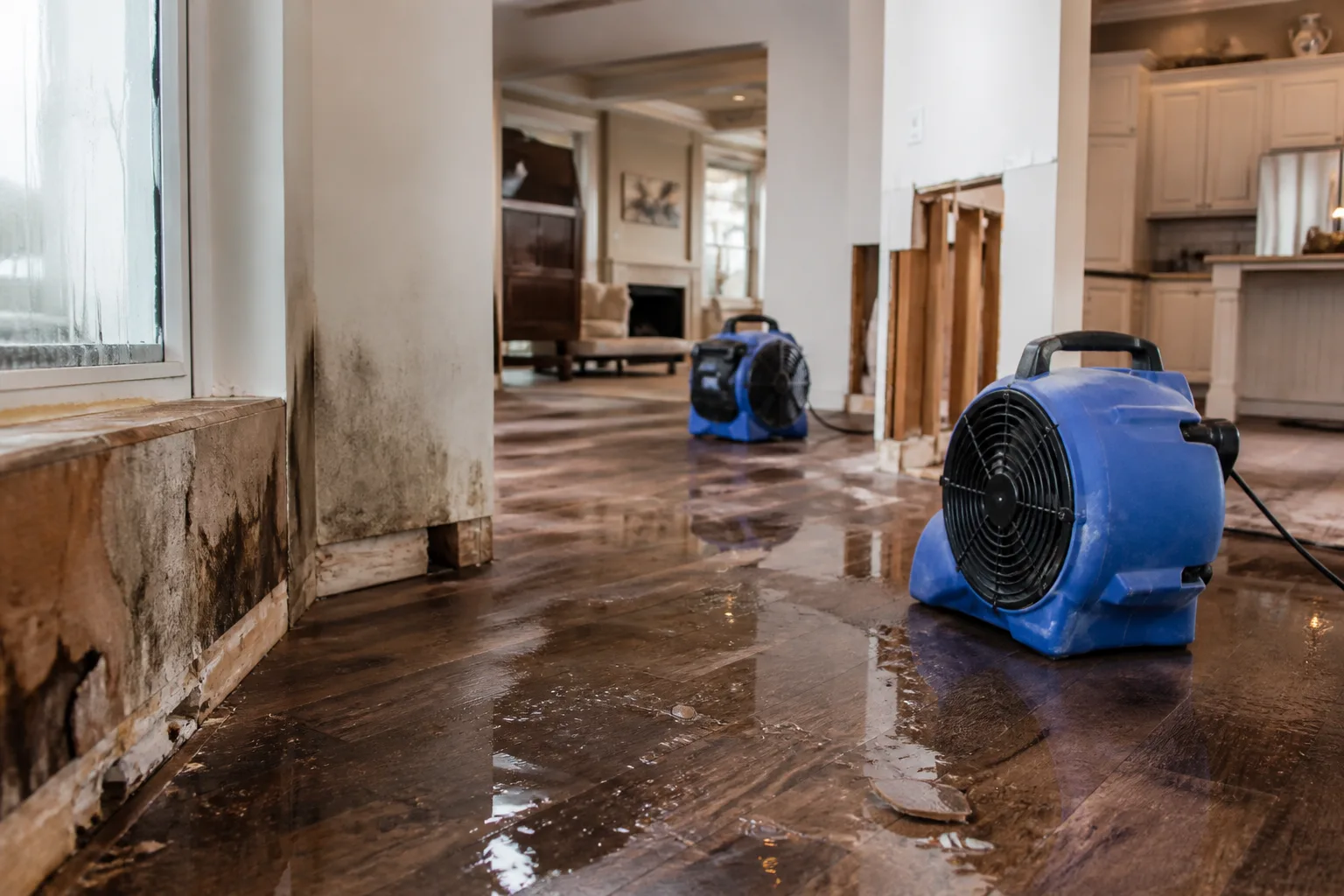
Water follows gravity and capillary action. It soaks into drywall, wicks up wall cavities, saturates subfloor, and settles into the bottom plate of framing. Within hours, not days, that hidden moisture begins attacking the materials it touched. Drywall starts losing structural integrity. Plywood subfloor swells and starts to delaminate. Insulation collapses and loses its R-value. None of this is visible from the surface, which is why the surface looking dry means almost nothing.
Professionals use moisture meters to map how far the water actually traveled and hygrometers to measure relative humidity in wall cavities. That data tells us where to place air movers and dehumidifiers. Without it, you’re guessing. The IICRC standard practice we follow is psychrometric drying, which is a fancy way of saying we track the air’s moisture level so we know when your home is truly dry, not just surface-dry. If you wait until water is gone before calling, the dry-out just got harder, longer, and more expensive. Call while the water is still there. Even a photo by text helps us tell you whether this is a “we can walk you through it” job or a “we need to be there in two hours” job.
Mistake 3: Accepting a Verbal Estimate With No Line-Item Breakdown
This one is quiet, and it costs homeowners thousands. A contractor walks through the house, nods, and says, “We’ll take care of it. Should run around $4,500. We’ll bill based on what we find.” Two weeks later, the invoice is $11,000 and the line items are vague: drying services, demolition, supplies. Good luck disputing that.
Water damage repair is not a mystery industry. The scope of work is knowable before anyone touches a wall. A proper written scope includes, at minimum:
- Square footage of affected area, by room
- Category and class of water, per IICRC standards
- Equipment list and daily rental count (air movers, dehumidifiers, injectidry mats)
- Demolition line items: wall cavity height, flooring type, cabinets affected
- Drying timeline estimate and monitoring schedule
- Clear language on what’s included, what’s excluded, and what would trigger a change order
“We’ll bill based on what we find” is a contract red flag. It hands the contractor an open checkbook. At Wendell, the price goes in writing before any work starts. You get a digital invoice texted to you, and the number on the screen is the number you pay. No surprises. If a change is genuinely necessary mid-job, it’s a written change order you approve first, not a post-dated surprise. In Los Angeles, where rebuild costs run higher than the national average, protecting yourself with a line-item scope isn’t cautious. It’s the only sane way to hire.
Mistake 4: Skipping Photos and Video Before Cleanup Starts
Every insurance adjuster on earth will ask the same two questions: what did it look like when you found it, and what did you do next. If you don’t have photos from that first hour, your claim is already weaker.
Documentation does three jobs. It establishes the initial condition for your insurer, it creates a factual timeline, and it protects you if a contractor dispute arises. Take photos before you move a single piece of furniture. Video too. Walk every affected room slowly, narrating what you see: “water is ankle deep in the hallway, baseboards are saturated, the carpet in the den is completely soaked.” Get the water source if it’s visible. Get the standing water line on the walls. Get every angle. Then photograph the cleanup as it happens.
This matters for insurance because adjusters work backward from evidence. A photo of a saturated baseboard pre-demo is worth two paragraphs of description post-demo. It matters for contractor disputes because if a crew cuts three feet of drywall and you believe only two feet were wet, the photo you took at hour one settles it. We send before-and-after photos by text on every job, not because we’re nice, but because it’s our record too. It protects you as much as it protects us. If a repair fails, those photos are the baseline for our 365-Day Done Right Promise. If it’s not done right, we make it right. That’s in writing on every job, and the photos are how we know what “right” looked like in the first place.
Mistake 5: Signing an Assignment of Benefits (AOB) Without Reading It
An Assignment of Benefits is exactly what it sounds like: you are signing over your insurance benefits to the contractor. The contractor then bills your insurer directly and, in theory, handles the claim paperwork. That sounds convenient, especially when you’re standing in three inches of water with a contractor’s tablet in your face at 11 p.m.
The catch is what you’re actually giving up. With an AOB, the contractor controls the claim. They negotiate the settlement. They decide what gets submitted. You, the homeowner, have been removed from your own insurance negotiation. If the contractor inflates the scope and the insurer pushes back, you’re not in the room. If the claim is denied, the contractor can file suit against the insurer in your name, and if they win, they get attorney fees added on. If they lose, you may still owe the contractor the billed amount outside of insurance. In some states, AOB abuse has been so rampant that insurers have changed policy language specifically to make it harder to sign one without a video acknowledgment.
There are legitimate uses for an AOB, but they typically involve catastrophic loss where the homeowner is not physically able to manage the claim. For routine water damage repair, you should be the one talking to your insurer. A good restoration company works with your adjuster directly, provides photo documentation, and helps you build the claim. A good company does not need an AOB. In Los Angeles, where many homeowners have never filed a water damage claim before, this contract is often the first document they see, and they sign it without reading past the first paragraph. Don’t. Read it. Ask what changes if you say no. If the answer is “nothing,” say no.
When to call a pro: if the water extends beyond one room, if it touches drywall and insulation, if it came from a sewer line or a toilet, if you smell something off, or if your insurance already told you to “mitigate and bill us,” stop reading and call. Water damage compounds hourly, not daily. Water Damage Restoration in Los Angeles starts with a moisture map and a drying plan, not a fan in a hallway.
The Bottom Line
Water damage repair usually fails in the first 24 hours, and it fails silently. The HVAC runs too early. The hidden moisture gets ignored. The verbal estimate turns into a surprise invoice. The photos never get taken. The AOB gets signed under pressure. All five are process mistakes, not emergency mistakes, which means all five are avoidable if you know what to look for. Keep the HVAC off until the category is confirmed. Call while the water is still visible, not after it’s gone. Refuse the verbal estimate. Photograph everything. Read every contract before you sign it. If you’re in Los Angeles and need help, Wendell Water Damage Restoration offers free estimates and a written price before any work starts. Call (940) 466-4354 and ask for help with any of the above. A live person answers, 24/7, and we’ll tell you what to do next whether you hire us or not.
Frequently Asked Questions
Shut off the water source if you can do so safely. Kill the electricity to the affected area at the breaker. Photograph and video everything before you move anything. Move dry items to a dry area if they’re not contaminated. Then call your insurance company and a restoration company. Don’t run the HVAC, don’t use a household fan on standing water, and don’t wait for visible water to disappear before calling.
Most homeowners policies cover sudden and accidental water damage from burst pipes, supply line failures, and appliance malfunctions. Gradual damage from leaks, poor maintenance, or neglect is generally not covered. Flooding from external sources requires a separate flood policy. We coordinate directly with adjusters and provide photo documentation to support your claim. Call us and ask – we’ll tell you honestly what we see.
Drying time depends on the category of water, how long it sat, and what got wet. A small clean-water event in one room can dry in 3 to 4 days with professional equipment. Gray or black water events involving multiple rooms and structural materials can take 5 to 10 days before reconstruction begins. Moisture meter readings tell us when it’s actually done, not the calendar.
Fans move surface air. They don’t remove bound moisture from wall cavities, subfloor, or framing. Without a dehumidifier sized to the room and a moisture meter to track progress, you’ll likely dry the surface and leave the structure wet. That’s how mold gets a foothold. If the affected area is small and Category 1 (clean water), you might manage with aggressive airflow and a good dehumidifier. If you’re not sure, call us and send a photo. We’ll tell you straight.
Related services in Los Angeles: Mold Remediation in Los Angeles and Water Damage Repair in Los Angeles.
Written by Blake Sorensen, Owner at Wendell Water Damage Restoration, serving Los Angeles since 2006.
Need Damage Restoration Help?
Call Wendell Water Damage Restoration - licensed & insured, here with fast after-hours help in Los Angeles.
(940) 466-4354