
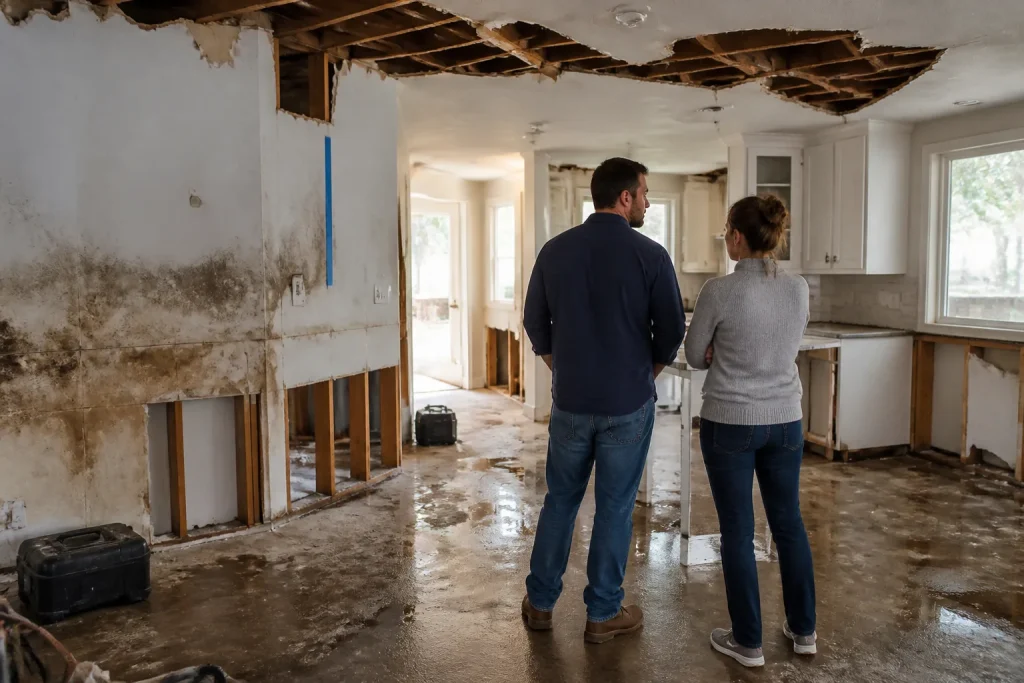
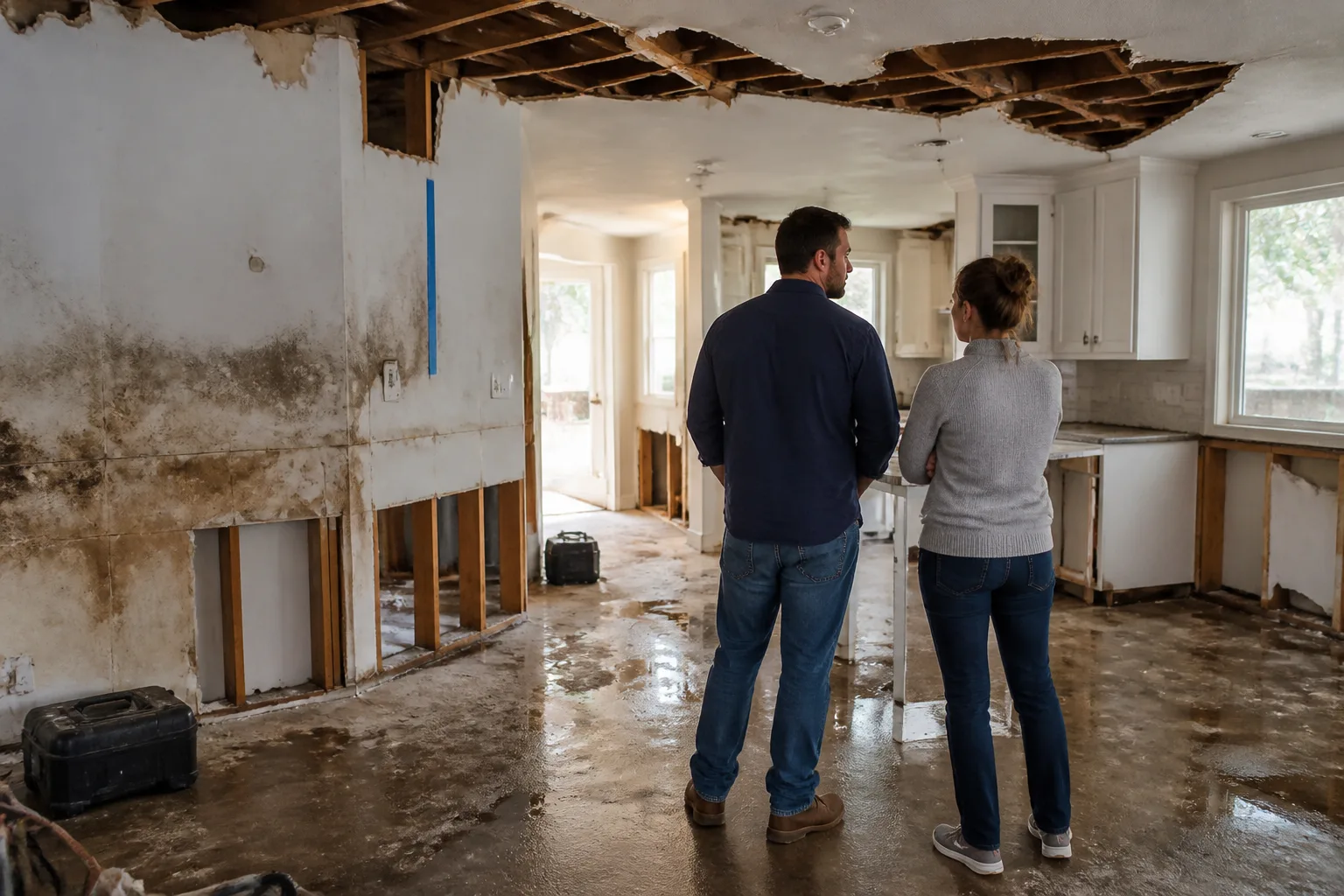
Water Damage Repair: Repair or Replace? How Los Angeles Homeowners Decide
Here’s the short answer: you repair what’s salvageable, replace what’s structurally compromised, and the line between those two comes down to three things – moisture content in the framing, the material that got wet, and how long the water sat. In Los Angeles, most drywall and trim can be dried and saved, while saturated particleboard, carpet pad, and swelling MDF almost always go. If you’d rather not sort this out yourself, call us at (940) 466-4354 for a free assessment – we’ll tell you the truth before a single tool comes off the truck.
But the longer answer matters, because the most expensive mistake we see in this city isn’t replacing too much. It’s replacing too little – or replacing at the wrong time. A homeowner rips out wet drywall, sees the studs look fine, puts up new drywall, paints, and six weeks later there’s a musty smell behind the baseboard. The studs were at 24% moisture content the whole time, quietly feeding mold inside the wall cavity. That’s the repair-or-replace decision done wrong, and it costs twice.
Why “It Looks Dry” Is the Most Expensive Thing You Can Believe
Water damage tells lies. Drywall can feel bone-dry to the touch while the wood framing behind it is still soaked. Paint blisters, hardwood cups, but the real damage – the structural one – happens inside the wall, under the floor, behind the cabinet toe kick. That’s the core of the repair-versus-replace decision: you’re not deciding based on what you can see. You’re deciding based on what a moisture meter says, and how long the material has been wet.
Here’s the number to know: 19% moisture content in wood framing. Below that, wood framing can typically be dried in place using professional equipment – fans, dehumidifiers, the whole science of it. Above 19%, you’re in dangerous territory. At that point, the lumber’s cellular structure has absorbed enough water that mold has a real foothold, and drying it out takes long enough that replacement usually makes more financial sense. Ask any restoration company – including us – to show you the moisture readings. If they can’t produce a number, that’s your answer about their process.
In Los Angeles, we deal with a specific wrinkle: the marine layer. A leak that sat over a cool, damp week in Santa Monica or Playa del Rey dries slower than the same leak in Woodland Hills in August. Ambient humidity is part of the drying equation. That’s why proper restoration uses psychrometric drying – which is a fancy way of saying we track the air’s moisture level, temperature, and air movement daily, so we know when your home is actually dry, not just surface-dry.
Key Takeaways:
- Below 19% moisture content in wood framing: drying in place is usually viable.
- Above 19%: replacement becomes the structurally sound choice.
- Drywall can feel dry while framing behind it is still wet – moisture meters are non-negotiable.
- LA’s coastal humidity slows drying; inland heat speeds it up. Both affect the repair timeline.
The Three Materials That Decide Repair vs. Replace (And What They Cost in LA)
Once you know the moisture content, the next variable is the material itself. Different materials have wildly different tolerance for saturation, and in Los Angeles, the replacement costs vary enough that this matters to your wallet.
Drywall
Drywall is the most forgiving material in a water event, which surprises people. If the water was clean – a supply line leak, a roof leak, an overflowing tub – drywall can often be cut out just at the water line and replaced in a patch. Standard 1/2-inch drywall in LA runs $1.50 to $3 per square foot installed, depending on finish level. The caveat: if the water sat for more than 48 hours, or if it was dirty water, we cut higher and wider. Drywall wicks upward like a sponge, and what looks stained at 18 inches is often damp at 30.
Flooring
Flooring is where the repair-versus-replace decision gets real expensive, fast.
- Carpet and pad: The pad always goes. Always. It’s a sponge that never truly dries. Carpet itself can sometimes be saved if it’s cleaned and dried within 24 to 48 hours with professional equipment, but in LA, most homeowners choose replacement because the cleaning cost approaches the cost of new carpet in many rooms.
- Engineered hardwood: This is the material that breaks hearts. Engineered hardwood has a thin veneer of real wood over a plywood or HDF core. The core swells when it gets wet, and once it swells, it doesn’t go back. Cupping, buckling, edge lift – these are replacement signals. We’ve salvaged small isolated areas with targeted drying and weight, but in our experience, any saturation beyond 24 hours means you’re replacing boards, often from the nearest doorway or transition.
- Tile over slab: Here’s the good news. Tile itself doesn’t absorb water. The issue is what’s under it – the slab and any mortar bed. In Los Angeles, where a huge portion of homes sit on concrete slab foundations, tile floors often survive clean-water events with just grout cleaning and slab drying. The subfloor is concrete; it doesn’t rot. But you still need to dry the slab thoroughly or you’ll trap moisture under the tile, which leads to efflorescence and eventually loose tile.
On the equipment side, professional restoration teams in LA use gear from brands like Dri-Eaz and Phoenix – the same portable and truck-mounted units used on large commercial losses. We deploy those under IICRC (Institute of Inspection, Cleaning and Restoration Certification), RIA (Restoration Industry Association), and IFA (International Flood Association) standards. That part matters when you’re comparing bids: the equipment and the protocol are what dry your framing below 19%, not the technician’s optimism.
The Insurance Question: When Adjusters Push Repair, and When You Have Standing to Push Back
Here’s a scenario we see every month in Los Angeles. A kitchen supply line bursts. The adjuster comes out, looks at the wet lower cabinets, and says “dry it and paint it.” The homeowner takes that at face value. Six months later, the cabinet doors are warped, the toe kick is swollen, and the insurance claim is closed – the homeowner eats the replacement out of pocket.
Insurance adjusters are not your adversary, but they work for a company with a budget. Their default position is usually the cheapest outcome that looks defensible. Your job, as the homeowner, is to arm yourself with data that makes the more expensive outcome the defensible one.
What that data looks like:
- Moisture-content readings taken at multiple points, documented over time, showing framing above 19% or not trending downward fast enough.
- Photo documentation of swelling, delamination, warping, or visible mold growth – the stuff that doesn’t show up on an adjuster’s one-hour visit.
- Drying logs that show the professional equipment ran for X number of days and the materials still didn’t hit target moisture levels. That’s your strongest evidence that “dry and paint” won’t work.
If your claim is substantial – say, $20,000 or more in disputed repair-versus-replace decisions – a public adjuster becomes worth the conversation. Public adjusters work for you, not the carrier, and they typically charge 10% to 20% of the settlement. For a $40,000 kitchen loss where the carrier wants to patch and you need to replace, that fee often pays for itself. If you’re in Los Angeles and navigating this, a good restoration company will document everything in a format the adjuster can’t argue with. We do this daily – written scope, photo updates by text, and moisture logs that are part of the permanent record, not a scribble on a clipboard.
Cabinets: The Most Contested Repair-or-Replace Item in LA Kitchens
If drywall is the easy call and flooring is the expensive one, cabinets are the one that starts arguments between homeowners, contractors, and adjusters. Here’s why: cabinets sit directly on the floor, where water pools first. They’re built from materials – particleboard, MDF, plywood with veneer – that actively absorb water and then fail structurally as they dry. But they’re also expensive to replace, so everyone wants to believe they’ll be fine.
Here are the structural signs that say “replace,” and they’re not subtle if you know where to look:
- Swelling at the toe kick: The toe kick is the lowest horizontal panel at the base of the cabinet. If it’s swollen, meaning it feels thicker or looks puffy compared to neighboring cabinets, water wicked up through it. Particleboard doesn’t un-swell. The structural base of the cabinet is compromised.
- Delamination at the back panel: Open a lower cabinet door and look at the back panel, which is usually thin plywood or hardboard. If it’s bubbling, peeling, or splitting into layers, the panel is permanently damaged and more importantly, the cabinet box itself has lost its structural shear panel – the thing that keeps the box square.
- Doors that no longer close square: When a cabinet box absorbs water unevenly, it twists. The doors start to bind, or the gap at the top of the door is different from the gap at the bottom. That twist means the box framing has changed shape. It’s not coming back.
We pulled one out of a condo over in Silver Lake last year where the homeowner had been told by another company that the lower cabinets were “fine, just water-stained.” They’d been sitting wet for five days before anyone arrived. When we removed the toe kick, the particleboard crumbled in our hands like wet cereal. The doors looked fine from the outside. The structure was gone underneath. That’s the repair-or-replace decision in one story: the surface lied, the structure didn’t.
How LA’s Disclosure Laws Change the Repair-or-Replace Math
Los Angeles homeowners have a financial reason to do this right that homeowners in some other states don’t face the same way: the Transfer Disclosure Statement. California Civil Code requires sellers to disclose known material facts about the property – including water damage and mold, even if it was “repaired.” This changes the repair-or-replace decision because how you fix the damage affects what you have to disclose later, and what the damage does to your eventual sale price.
Here’s the distinction that matters. If you have a leak, and you do proper restoration with documentation – moisture readings, drying logs, before-and-after photos, and a written scope from a company like Wendell Water Damage Restoration home – then you disclose a fully resolved issue with a paper trail. That’s a much smaller resale haircut than disclosing “there was a water leak and we patched it ourselves.” An undocumented patch job invites the buyer’s inspector to find what you missed, and if they find it, you’re either renegotiating on price or losing the deal.
If this is a bigger situation, Water Damage Restoration in Los Angeles done right – with full documentation – becomes part of your home’s value story, not a liability. The same applies when water damage leads to microbial growth; Mold Remediation in Los Angeles with post-remediation clearance testing is a stronger disclosure position than a DIY bleach job, which often makes the disclosure worse because the buyer knows mold was present and can’t verify it was actually removed.
When to Call a Pro
If you’ve read this far and you’re looking at your own water-damaged situation, here’s the honest threshold: if you can see swelling, wicking, or staining that’s more than a square foot, or if water sat anywhere for more than 24 hours, get a professional assessment. The moisture meter is the only tool that tells you the truth, and a good company will show you the readings and explain what they mean – then put the plan in writing before any work starts. If you’re in Los Angeles, Water Damage Repair in Los Angeles from a team that documents everything is worth the call, even if you end up doing some of the work yourself. At minimum, you’ll know the number on the moisture meter and what it means for your specific walls, floors, and cabinets.
The Bottom Line
Repair versus replace isn’t a guess or a preference. It’s a data decision. Get the moisture content of the framing. Know the saturation tolerance of the materials that got wet. Document everything, especially in Los Angeles where the Transfer Disclosure Statement makes that documentation part of your home’s resale value. Below 19% moisture content, drying in place through professional standards like IICRC, RIA, and IFA protocols usually works. Above 19%, or with materials like particleboard and carpet pad, replacement is the honest answer – and often the cheaper long-term one, because replacing wet materials before mold has time to colonize is always less expensive than Mold Remediation in Los Angeles six weeks later.
If you’re in Los Angeles and you want a straight answer on repair versus replace, Wendell Water Damage Restoration offers free assessments with moisture readings, a written price before any work starts, and the 365-Day Done Right Promise on every repair. Call (940) 466-4354 – a live person answers, 24/7, because water damage does not keep business hours, and neither do we.
Frequently Asked Questions
If the drywall is stained, soft, or crumbling, replace it. If the water was clean and the drywall was only wet for a few hours, you may be able to dry it with professional air movers and dehumidifiers – but only if the moisture content of the surrounding framing stays below 19%. In Los Angeles, our team checks both the drywall and the studs behind it before making the call. When in doubt, cut it out: new drywall is cheap compared to mold remediation. Call (940) 466-4354 for a free assessment with moisture readings.
Your policy language controls the answer, but most homeowner policies cover repair when materials can be restored to pre-loss condition, and replacement when they can’t. The deciding evidence is usually moisture data. If a restoration company documents that framing stayed above 19% moisture content for days despite professional drying, that’s strong support for replacement. A public adjuster can help in Los Angeles on larger claims where the carrier and the homeowner disagree. We document every job with photo and moisture logs in a format adjusters accept.
Solid-wood face frames can sometimes be sanded and refinished if they didn’t absorb much water. But particleboard boxes, swollen toe kicks, delaminated back panels, and doors that no longer close square are all replacement indicators. The problem with “repairing” a water-damaged cabinet box is that the structural panel has already lost its integrity – paint hides the stain but not the twisted frame. In our experience across Los Angeles kitchens, lower cabinets that sat in water for more than 48 hours are replacement candidates more often than not. We’ll tell you straight, and our written price reflects what the structure needs, not what’s easiest.
You have roughly 24 to 48 hours to start professional drying before mold becomes a real possibility in most Los Angeles conditions. Coastal humidity stretches that window shorter; inland heat can extend it slightly on the drying side. The practical answer: call within hours, not days. Standing water migrates, wicks upward into drywall, moves under flooring, and finds its way into wall cavities. Every day of delay expands the repair footprint and pushes more materials from the “repair” column to the “replace” column. Wendell Water Damage Restoration answers live 24/7 at (940) 466-4354, and we can usually get a technician to your Los Angeles home the same day you call.
Written by Blake Sorensen, Owner at Wendell Water Damage Restoration, serving Los Angeles since 2006.
Need Damage Restoration Help?
Call Wendell Water Damage Restoration - licensed & insured, here with fast after-hours help in Los Angeles.
(940) 466-4354