
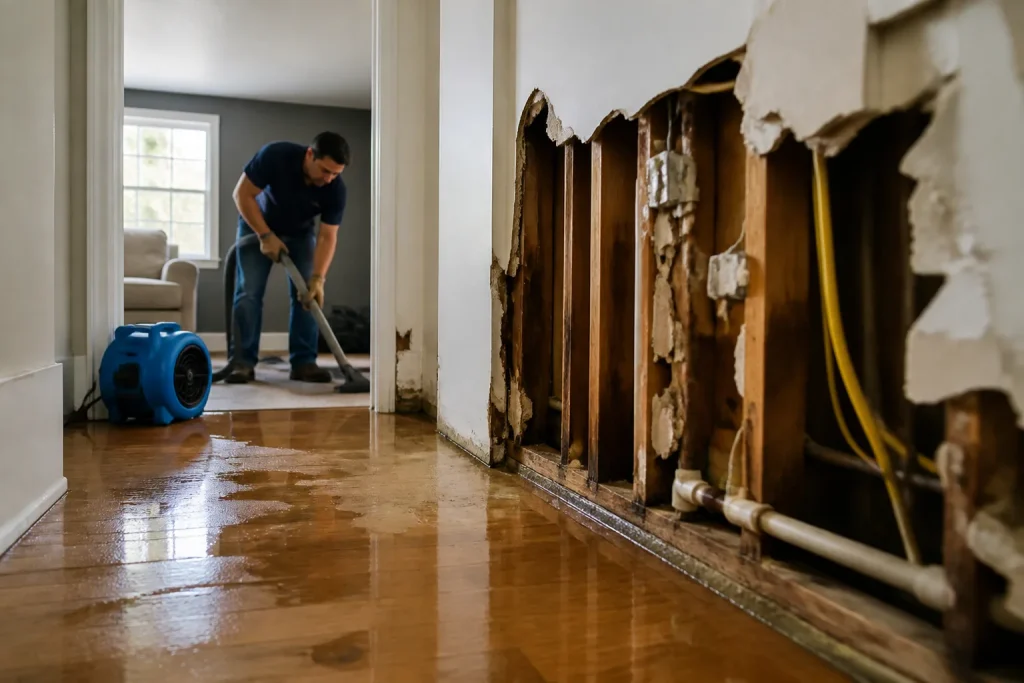
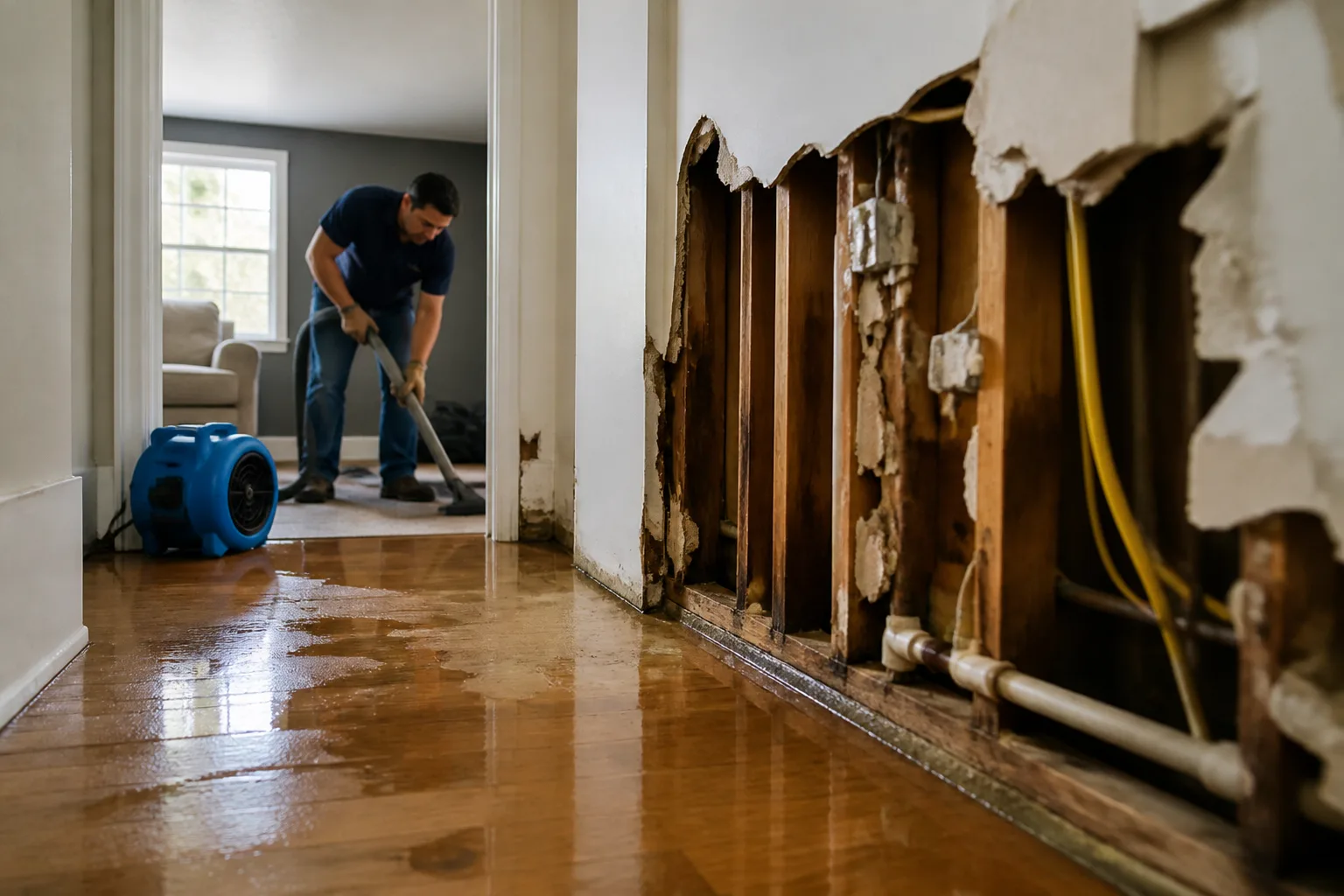
B-Air Water Damage Restoration in Los Angeles: A Homeowner’s Guide
B-Air water damage restoration in Los Angeles typically costs $2,800 to $6,400 for a full dry-out, with B-Air LGR dehumidifiers being the professional-grade workhorses that make true structural drying possible. Those little plastic units you rent from the hardware store stop pulling water from the air once humidity hits about 45%. Your wall cavity, meanwhile, can sit at 80% humidity for weeks. If you’d rather skip the science project and talk to someone who does this every day, call Wendell Water Damage Restoration at (940) 466-4354.
Key Takeaways
- B-Air’s Vantage series are Low Grain Refrigerant (LGR) dehumidifiers, which keep working efficiently below 45% relative humidity, unlike standard refrigerant units.
- LGR placement and daily condensate monitoring are the two things that separate a real dry-out from an expensive fan rental.
- Los Angeles’s older stucco and plaster homes from the 1920s through 1950s need different drying strategy than 1980s drywall builds.
- A written daily moisture log is not a nice-to-have. It’s the proof that the drying system is actually working.
Why a Standard Dehumidifier Fails on Water Damage
Walk into any Los Angeles big-box store after a plumbing leak and you’ll see homeowners loading up on portable dehumidifiers that cost a few hundred dollars. It seems logical. The floor is wet. Dehumidifiers remove moisture from air. Problem solved.
Except it’s not. Standard refrigerant dehumidifiers work by pulling humid air across cold coils. Water condenses on those coils and drips into a bucket. The process is efficient in damp air, but once relative humidity falls below about 45%, the coils can’t get cold enough to condense more water without freezing up. The unit effectively stops drying. The bucket stops filling. You think things are fine.
Meanwhile, behind your baseboard, inside the wall cavity, in the subfloor, moisture levels are nowhere near 45%. They’re at 70, 80, sometimes 90%. Mold starts growing at 60%. The big-box unit has told you the job is done by simply stopping its bucket accumulation, while your wall is quietly becoming a biology experiment.
What Makes B-Air LGR Units Different
B-Air’s Vantage series dehumidifiers are Low Grain Refrigerant units, and that “LGR” designation matters more than most homeowners realize. In plain terms: an LGR dehumidifier uses a double-cooling system that pre-cools the incoming air before it hits the main evaporator coil. This means the coils stay cold enough to condense water out of air down to around 30 to 35% relative humidity, not 45%.
That extra 10 to 15% range is the difference between surface-dry and structurally dry. When you’re trying to pull moisture out of a plaster wall in an Echo Park bungalow or a drywall ceiling in a Woodland Hills home, that deeper humidity range is where the water actually lets go of the material. The International Inspection Cleaning and Restoration Certification (IICRC) sets drying standards that require equipment capable of hitting these lower humidity levels. B-Air LGR units meet that bar.
In our experience, we have watched a big-box unit hit its floor at 45% humidity and stop collecting water entirely, while the B-Air LGR next to it kept pulling pints per hour for another two days. That’s the hidden difference, and it’s exactly why professional Los Angeles water damage restoration companies use equipment like B-Air rather than what’s on the shelf at the home store.
B-Air on Category 2 “Gray Water” Jobs in Los Angeles
Water damage gets categorized by contamination level. Category 1 is clean water from a supply line or broken faucet. Category 2 is “gray water,” which has some contamination and can come from washing machine overflows, dishwasher leaks, or toilet backups without solid waste. Category 3 is sewage or flood water. Los Angeles homeowners dealing with a Category 2 loss face a specific race against time: gray water starts supporting microbial growth within 24 to 48 hours.
This is where the LGR advantage really shows. A B-Air LGR unit’s ability to drop relative humidity into the low 30s means you’re removing the moisture that microbes need to reproduce, faster than a standard unit ever could. When a technician places B-Air LGRs on a Category 2 job, they’re not just drying the structure. They’re cutting the window where bacteria and mold can establish themselves.
On jobs like an overflowing laundry room in Atwater Village or a dishwasher leak in Studio City, the drying strategy has to account for the microbes already present in the water. B-Air’s extraction rate, measured in pints per day, gives the drying system the headroom it needs to outpace microbial growth. A standard dehumidifier simply doesn’t pull water fast enough in those first 48 hours.
Los Angeles Building Stock and Drying Strategy
Los Angeles is not one construction type. A 1930s Spanish bungalow in Silver Lake with plaster walls and lathe underneath dries completely differently than a 1980s drywall townhouse in Sherman Oaks. Plaster and lathe hold moisture differently. Plaster is dense and slow to release water. The wood lathe behind it can stay damp for weeks if humidity stays above 45%. Drywall, by contrast, wicks water fast and dries from the surface inward.
A technician who understands this difference places B-Air LGR dehumidifiers differently depending on the home. In an older plaster home, you need sustained lower humidity levels for longer periods, because the plaster releases water slowly. You also need air movement across the surface to encourage evaporation. In a drywall home, you can often get away with a shorter, more aggressive drying period.
We have pulled B-Air LGR units out of a 1940s stucco home in Highland Park where the drying took a full six days, and out of a 1985 drywall condo in Culver City where the same model finished in three. Same water loss type, different materials, completely different timelines. Any Los Angeles restoration contractor who treats those two homes the same is not doing proper psychrometric drying (tracking the air’s moisture level so we know when your home is truly dry, not just surface-dry).
Noise, Displacement, and What to Expect During a Dry-Out
B-Air LGR dehumidifiers run continuously for days. Not hours. Days. They are not subtle machines. You’re going to hear them. An LGR unit sounds roughly like a window air conditioner running on high, and when multiple units are running in an enclosed space, the noise adds up quickly.
Plan on sleeping in a different room than where the equipment is running. The dehumidifiers also generate heat. Drying a Los Angeles bedroom in August means that room is going to be noticeably warmer than the rest of the house. Some homeowners in the San Fernando Valley during summer can find the added heat unpleasant. That’s normal and expected.
A legitimate restoration company will document what equipment was placed, where it was placed, and what the daily moisture readings were. You should expect a daily log showing relative humidity and moisture content of affected building materials. If your contractor can’t show you that log or just shrugs when you ask, that’s a red flag. The same goes for the equipment itself. B-Air LGR units used for water damage restoration in Los Angeles should be labeled, clean, and clearly professional-grade, not something that looks like it came from a garage sale.
Condensate: The Proof the System Is Working
Every dehumidifier produces water. That water, called condensate, has to go somewhere. On a standard homeowner unit, it fills a small bucket you empty. On a B-Air LGR, the condensate is routed through a hose to a drain, a sink, or outside. The key point is that the amount of condensate tells you whether the drying system is actually pulling water out of your home.
A B-Air LGR on an active water damage job should produce significant water in the first 48 to 72 hours. On a heavy category 2 loss in a Los Angeles home, multiple units can pull several gallons per day combined in those early stages. As the structure dries, the condensate volume drops. By day five or six, it may be minimal. That decline is the evidence that the system is doing its job.
Ask your contractor to show you the daily extraction volume. The best restoration companies track this in writing. If a unit is running for days and producing almost no condensate, either the unit is malfunctioning, it’s placed incorrectly, or the home isn’t actually as wet as the contractor claimed. In any of those cases, you should be asking questions.
When to Call a Pro
If your water damage involves a Category 2 or 3 loss, soaked drywall, standing water for more than 24 hours, or water that has reached wall cavities or subfloor, this is not a DIY drying situation. The equipment matters. The placement matters. The daily monitoring matters. A B-Air LGR unit costs thousands of dollars, and running it without knowing how to measure moisture content or place it for your home’s specific construction means you’re guessing. Guessing with mold on the line is a bad bet.
That does not mean every small spill needs a full restoration company. A broken water bottle on a tile floor is a mop job. A supply line burst that soaked a bedroom carpet and pad is a different situation entirely. The line is drawn at whether the water penetrated building materials you can’t see.
Related services in Los Angeles: Water Damage Restoration in Los Angeles and Mold Remediation in Los Angeles cover the full scope of what happens after a water event, from first extraction through mold prevention. If you need repairs after the dry-out, see Water Damage Repair in Los Angeles.
The Bottom Line
B-Air water damage restoration in Los Angeles comes down to equipment matching the moisture problem, not just moving air around. The B-Air Vantage LGR series represents the professional standard because it reaches humidity levels that standard units physically cannot. On Category 2 jobs, that lower humidity range cuts the microbial growth window. On older Los Angeles plaster homes, it gives the structure enough time to release deep moisture. And the daily condensate and moisture logs are the proof that the process is working.
If you’re in Los Angeles and dealing with water damage that has gotten into walls, floors, or ceilings, Wendell Water Damage Restoration offers free estimates. You’ll get a written price before any work starts, a live arrival time you can track, and before-and-after photo updates by text. Call (940) 466-4354 to talk through your situation with a live person, 24/7.
Frequently Asked Questions
Full structural drying with B-Air LGR equipment in Los Angeles typically runs $2,800 to $6,400 depending on the size of the affected area and the Category of water involved. Category 2 gray water jobs cost more than clean water losses because they require antimicrobial treatment after drying. Call (940) 466-4354 for a written estimate specific to your home.
For water that has soaked into drywall, plaster, subfloor, or wall cavities, a home dehumidifier will not reach the low humidity levels needed to prevent mold growth. You also won’t have a way to measure moisture content inside building materials to know when the job is actually done. For water that has penetrated the structure, professional LGR equipment and moisture monitoring are the standard.
Most Los Angeles water damage dry-outs using B-Air LGR equipment run three to six days. Older plaster and lathe construction in homes from the 1920s through 1950s typically dries on the longer end of that range due to how slowly plaster releases moisture. Drywall homes from the 1980s onward often finish in three to four days. Daily moisture logs should show the progress.
Insurance coverage depends on the source of the water. Sudden and accidental events like a burst supply line or appliance overflow are typically covered. Gradual leaks, sewer backups without a specific rider, and flood events often are not. A restoration company that provides photo documentation and moisture readings can give your adjuster exactly what they need. Wendell Water Damage Restoration works directly with your insurance adjuster and documents every step of the job.
Written by the team at Wendell Water Damage Restoration.
Need Damage Restoration Help?
Call Wendell Water Damage Restoration - licensed & insured, here with fast after-hours help in Los Angeles.
(940) 466-4354