
Mold Remediation: Repair or Replace? How Los Angeles Homeowners Decide
Most Los Angeles homeowners assume the repair-or-replace call comes down to how much mold they can see. It doesn’t. The real driver is which contamination class your home falls into under EPA and IICRC standards: Condition 1, Condition 2, or Condition 3. That classification, not square footage of visible growth, determines whether a material gets cleaned and kept or cut out and hauled away. If you’d rather not figure this out alone, call (940) 466-4354 and we’ll walk you through it.
Why Two LA Homes With ‘Some Mold on the Wall’ Get Wildly Different Estimates
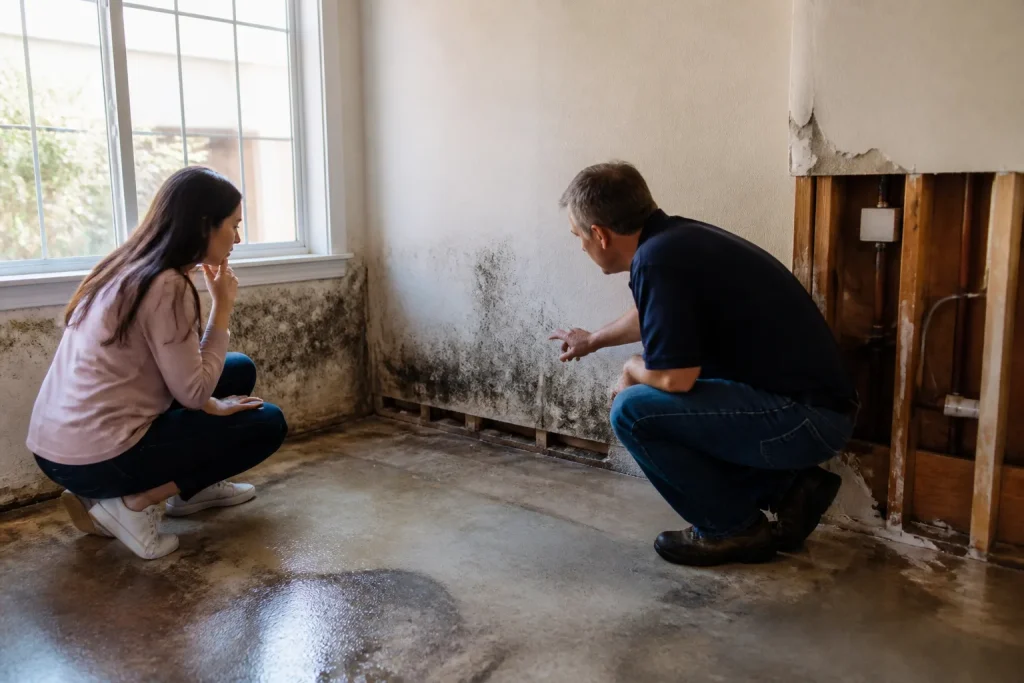
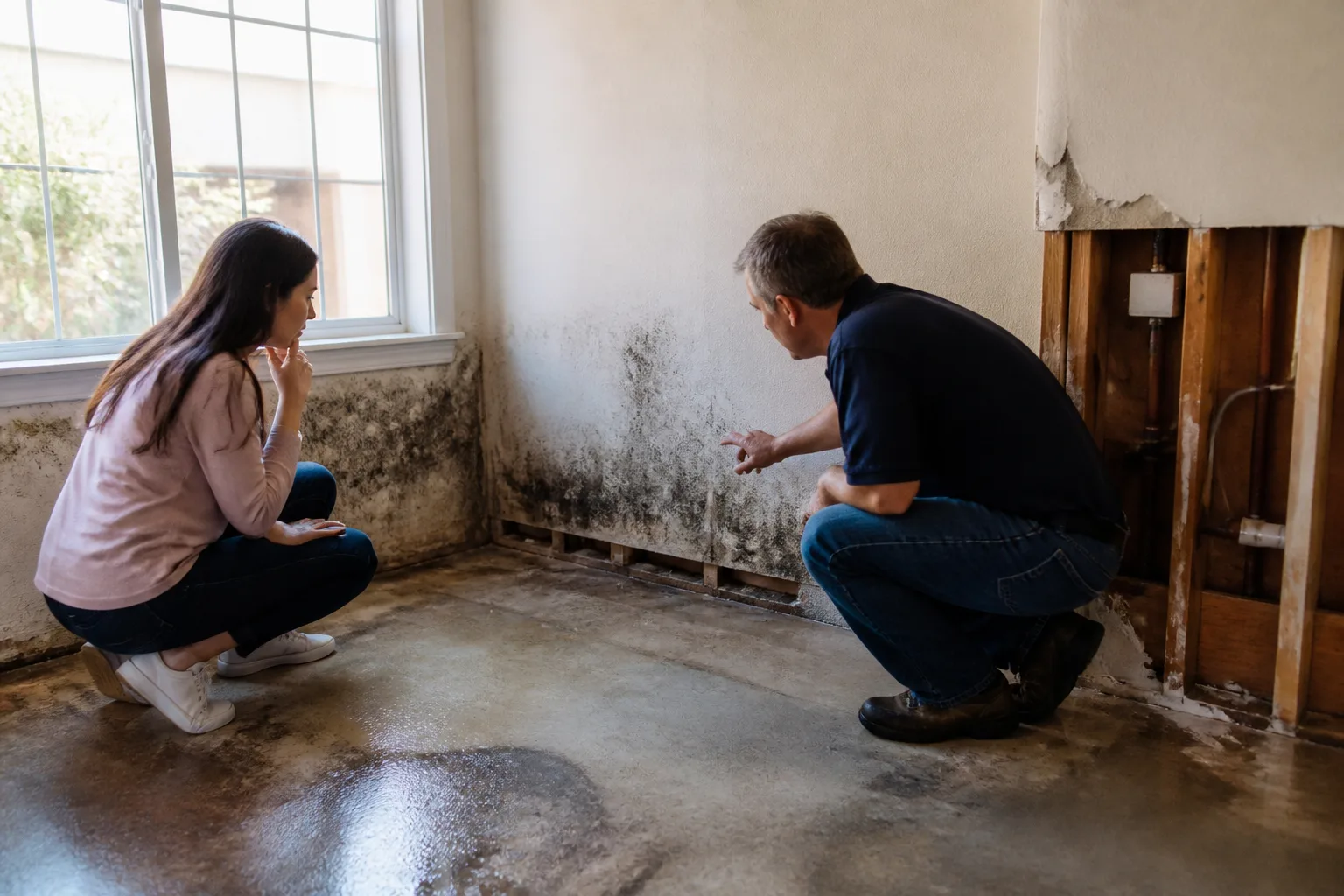
We’ve pulled mold estimates off the same block in Los Angeles ranging from $1,800 to $28,000. Both homeowners described the problem the same way: dark spots, musty smell, maybe a bathroom ceiling. The difference? One had surface mold on a non-porous tile wall. The other had mold that had colonized the drywall cavity behind the surface, running along the studs and into the insulation.
That’s the gap. Visible mold is the symptom. What’s behind the surface and how far the contamination has spread is the actual job. A contractor who gives you a number without opening up a section of wall or running moisture readings is pricing a guess. In Los Angeles, where 1940s stucco-over-wood construction and post-1980s drywall sit side by side, the materials behind the mold change the price by an order of magnitude. Knowing the classification system before you get three bids is the single best way to avoid paying for a full gut when a targeted repair would do, or accepting a cheap cleaning that leaves active mold behind the paint.
Understanding Condition 1, 2, and 3: The Scale That Actually Drives the Decision
Mold remediation professionals, including our team at Wendell Water Damage Restoration home, classify every job using a three-level system from the EPA and IICRC S520 standard. It’s not jargon for its own sake. Each level dictates what gets replaced, what gets cleaned, and how much containment is required.
- Condition 1 (normal fungal ecology): This is a normal indoor environment. You’ll find some mold spores in any Los Angeles home, same as every home on earth. No visible growth, no water damage, no amplification. Nothing to repair. This is the baseline your home should be returned to after remediation.
- Condition 2 (settled spores): Mold spores have been carried in from somewhere else and settled on surfaces, but there’s no active growth. Think of a water leak in one room that sent spores through the HVAC system into an adjacent hallway. Condition 2 typically requires HEPA vacuuming and antimicrobial treatment of surfaces, but not demolition. Most materials stay put.
- Condition 3 (actual growth): Mold is actively growing and amplifying on building materials. This is where the repair-or-replace decision gets real. In Condition 3, porous materials that support mold growth usually get removed. Non-porous materials get cleaned, treated, and kept. The extent of Condition 3 contamination drives the price more than anything else on the work order.
Here’s the point every Los Angeles homeowner should internalize: if a contractor recommends tearing out a wall, ask them to state the condition level of the affected materials and show you the visual evidence. If they can’t speak to Condition 1, 2, and 3, they’re not following the industry standard.
Where the ’10 Square Foot Rule’ Comes From, and When It Fails in Los Angeles
You may have seen a government or insurance reference to 10 square feet as the DIY threshold. That number traces back to EPA guidance for schools and commercial buildings: under roughly 10 square feet of visible mold, an experienced remediation technician may not need full containment. Over that area, professional protocol kicks in.
But the 10-square-foot rule has two serious flaws as applied to Los Angeles homes. First, it’s based on visible area only. A 6-inch spot on a bathroom wall can be the visible face of a 40-square-foot cavity problem behind the drywall. Second, LA’s construction stock includes a lot of pre-1980s homes with plaster and lathe over wood framing, plus a wave of 1950s and 60s tract housing built with minimal vapor barriers. Those wall assemblies hold moisture differently than modern construction, and mold travels through them in ways that surface square footage can’t predict.
Our rule of thumb: if you’re deciding between DIY and professional help, the visible patch size matters less than whether you can confirm the mold is only on the surface. Can you see a clean edge? Is the material solid, not soft? If any part of that answer is uncertain, the smart move is a professional assessment before you start tearing things open.
Porous, Semi-Porous, and Non-Porous: What Actually Gets Replaced
Mold remediation in Los Angeles is ultimately a materials decision. The porosity of what’s contaminated determines whether it’s salvageable. Here’s how the categories break down on real jobs:
- Porous materials (usually replaced): Drywall, ceiling tiles, insulation, carpet pad, upholstered items. Mold roots penetrate deep into these materials. You can clean the surface, but the mycelium inside stays alive and regrows when humidity spikes. In our experience, drywall in Condition 3 almost always gets cut out and replaced, not because remediation companies want the extra demo, but because it’s the only way to hit Condition 1. That’s standard under IICRC S520.
- Semi-porous materials (the gray zone): Wood framing, OSB sheathing, some stucco, engineered wood. This is where experienced judgment matters. Light surface mold on a stud can often be sanded, HEPA-vacuumed, and treated with an antimicrobial. Heavy colonization that has softened the wood or penetrated deep grain may need full or partial replacement. Los Angeles homes with older Douglas fir framing tend to clean up better than newer lumber because the old-growth grain is denser and less absorbent. We don’t make this call until the material is visible and touched.
- Non-porous materials (almost never replaced): Tile, glass, porcelain, metal, sealed concrete, hard plastic. Mold can’t penetrate these surfaces. They get scrubbed, treated with antimicrobial, and left in place. We’ve seen a tile bathroom in a San Fernando Valley house look like a horror movie on the surface and clean up to Condition 1 in a single afternoon. The tile never needed to come out.
Insulation deserves a quick specific callout. Fiberglass batt insulation is porous and impossible to effectively clean once wet or moldy. It comes out. Closed-cell spray foam is non-porous and usually stays. Blown-in cellulose in LA attics? That’s a porous material, and moldy sections get vacuumed out and replaced. If a contractor tells you they can “clean” fiberglass batt insulation, that’s a red flag.
Post-Remediation Verification: The Test That Proves the Job Is Done
Here’s the part most Los Angeles homeowners skip because no one tells them it exists. After the demolition, cleaning, and antimicrobial treatment, a competent remediation company runs PRV: post-remediation verification. That means air and surface sampling taken inside the containment area and compared against a control sample from outside or an unaffected room. The goal is to confirm the affected space has returned to Condition 1, meaning indoor mold spore levels are at or below the outdoor baseline and no active growth remains.
Why PRV matters: you’re about to have new drywall hung, new insulation installed, and fresh paint applied. If mold spores or active growth remain in the wall cavity, you’re sealing the problem in a tomb. And in Los Angeles, where humid marine air from the coast or a leaky roof in the canyons can spike indoor humidity year-round, a sealed-in mold pocket will find moisture and come back. Requiring PRV before drywall goes back up is the difference between a repair that lasts and a remediation you pay for twice. At Mold Remediation in Los Angeles, every remediation we perform includes PRV as a matter of protocol, not as an optional upsell.
How the Insurance Angle Works in Los Angeles: Documentation Is Everything
Mold claims are where insurance companies hold the cards, and Los Angeles homeowners often learn this the hard way. Most homeowner policies cover mold remediation only if the mold growth can be linked to a covered water event: a pipe burst, a water heater failure, an AC overflow. If the insurer decides the mold came from long-term humidity or a slow leak you “should have caught,” the claim gets denied.
That’s where documentation becomes your only leverage. The single most valuable piece of evidence you can hold is a photo-dated record from the original water damage event. If you had water damage restoration done and the company took timestamped photos showing the water loss and the initial drying effort, those photos connect the mold to the covered cause. If you didn’t, and you’re trying to file a mold claim now with a stack of current photos and nothing from before, your adjuster will ask the obvious question: how do we know this mold didn’t pre-date the leak?
This is exactly why we send before-and-after photos by text on every job and document moisture readings, drying progress, and material condition in writing. In our experience handling water and mold work across Los Angeles, the claims that get approved aren’t the ones with the most dramatic photos. They’re the ones with the cleanest paper trail from day one.
When to Call a Pro in Los Angeles
Here’s the honest line. If the mold is on a non-porous surface, smaller than a dinner plate, and you can see the full extent with no water source behind it, a homeowner with proper PPE (N95 or better, gloves, eye protection) can handle a targeted cleaning. That’s not us protecting territory, that’s the EPA’s own guidance on moderate surface mold.
You should call a professional when any of these apply: you can smell mold but can’t see the full extent of it, the affected area is on drywall or another porous material, anyone in the home has respiratory issues or immune concerns, the mold is in HVAC ducting or an enclosed cavity, or the moisture source isn’t fully identified and fixed. Ripping open a wall with active mold behind it without containment sends spores through the entire house. If you’re anywhere in Los Angeles and not sure which bucket you’re in, call us and we’ll talk it through before you spend a dollar.
Related Services in Los Angeles
Mold rarely shows up alone in this city. Most of our remediation work starts as a leak that’s been seeping for weeks or a water heater that gave out while no one was home. If you’re seeing mold, you almost certainly have a moisture problem underneath it. Our Water Damage Restoration in Los Angeles team finds the water source and stops it, and our Water Damage Repair in Los Angeles crew rebuilds what the water and mold took out. The three jobs connect, and fixing them in the right order is what prevents a repeat.
What happens when you call
- 1
A real person answersNo phone trees - you reach a local pro.
- 2
You get an upfront price rangeHonest numbers before anyone is dispatched.
- 3
A background-checked tech heads outLicensed & insured, dispatched right away.
- 4
You approve before work beginsNothing starts until you say go.
The Bottom Line
The repair-or-replace call in mold remediation comes down to three things: what contamination class your home is in, what materials are affected, and whether you have PRV confirming the job’s actually done. Drywall, insulation, and most porous materials get replaced in Condition 3. Tile, glass, and metal get cleaned and stay. The gray zone is wood framing, and that call should be made by someone who can show you the material and explain the reasoning. If you’re in Los Angeles and staring at mold, don’t guess. Wendell Water Damage Restoration gives you a written price before any work starts, and every job includes the Done Right Promise in writing. Call (940) 466-4354 for a free estimate, and we’ll tell you exactly what needs to go, what can stay, and what it costs before we touch a single tool.
Frequently Asked Questions
It depends on the material. Non-porous surfaces like tile, glass, and metal can be cleaned and treated. Porous materials like drywall, insulation, and carpet pad in Condition 3 (active growth) almost always need removal because mold penetrates too deep for surface cleaning to work. Semi-porous materials like wood framing depend on how deep the mold has gone. A professional assessment will tell you which category your specific materials fall into.
The 10 square foot threshold comes from EPA guidance suggesting larger areas of visible mold warrant professional containment. But it’s based only on visible area, which means a small surface patch with a big hidden cavity problem can still require full professional remediation. In Los Angeles homes with older construction, visible area is often a poor predictor of total contamination. When in doubt, get a professional look before you open anything up.
Only if the mold can be linked to a covered water event like a pipe burst or appliance failure. Insurers typically deny mold claims tied to long-term humidity or slow leaks they say you should have caught. Photo-dated documentation from the original water damage is your best evidence. If you don’t have it, your adjuster will likely ask how they know the mold wasn’t already there. Call (940) 466-4354 and we’ll help you understand what documentation matters for your specific situation.
Post-remediation verification (PRV) is air and surface sampling done after mold removal to confirm your home has returned to Condition 1, the normal fungal ecology baseline. Yes, you need it. Without PRV, you’re hanging new drywall over a cavity that may still have active mold, which means the problem comes back and you pay for it again. Any competent remediation company includes PRV before reconstruction begins. If they don’t, that’s a red flag.
Written by the team at Wendell Water Damage Restoration.
Need Damage Restoration Help?
Call Wendell Water Damage Restoration - licensed & insured, here with fast after-hours help in Los Angeles.
(940) 466-4354