
5 Mistakes to Avoid With Water Damage Restoration
Water damage restoration mistakes fall into two camps: the ones contractors make, and the ones homeowners make before a contractor ever picks up the phone. The second camp costs more. In our experience across Los Angeles, the first 48 hours decide whether a $3,200 dry-out ends cleanly or becomes a $14,000 mold remediation plus rebuild. We pulled one out of a garage in Studio City last month where a homeowner ran three box fans over standing water for a day before calling us. The moisture mapping showed elevated relative humidity inside wall cavities twelve feet from the original leak. The fans hadn’t dried anything. They had just moved damp air into places that were previously dry.
Here are the five mistakes we see again and again, and how to avoid each one.
Mistake 1: Running household fans before the water is extracted
This is the mistake behind our Studio City example, and it’s the most common one homeowners make in Los Angeles. It feels productive. You see water on the floor, you grab every fan you own, you point them at the puddle, and you feel like you’re doing something. You are doing something: you’re distributing moisture.
Evaporation without extraction is a physics problem. Water does not disappear when it evaporates. It changes form: from liquid water to water vapor suspended in the air. Without a professional extraction machine pulling the bulk water out first, that vapor simply moves through your home. It enters wall cavities. It condenses on cooler surfaces. It soaks into drywall, baseboards, and subflooring. You haven’t removed water; you’ve relocated it.
In Category 2 water events (gray water from washing machines, dishwashers, or clean toilet overflows without waste) and Category 3 water events (sewage backups, floodwater, any water that contains bacteria), fans make things worse. Air movement lifts contaminants off the surface and carries them into places that were never wet. What started as a contained puddle in a laundry room becomes airborne bacteria settling into bedrooms and closets.
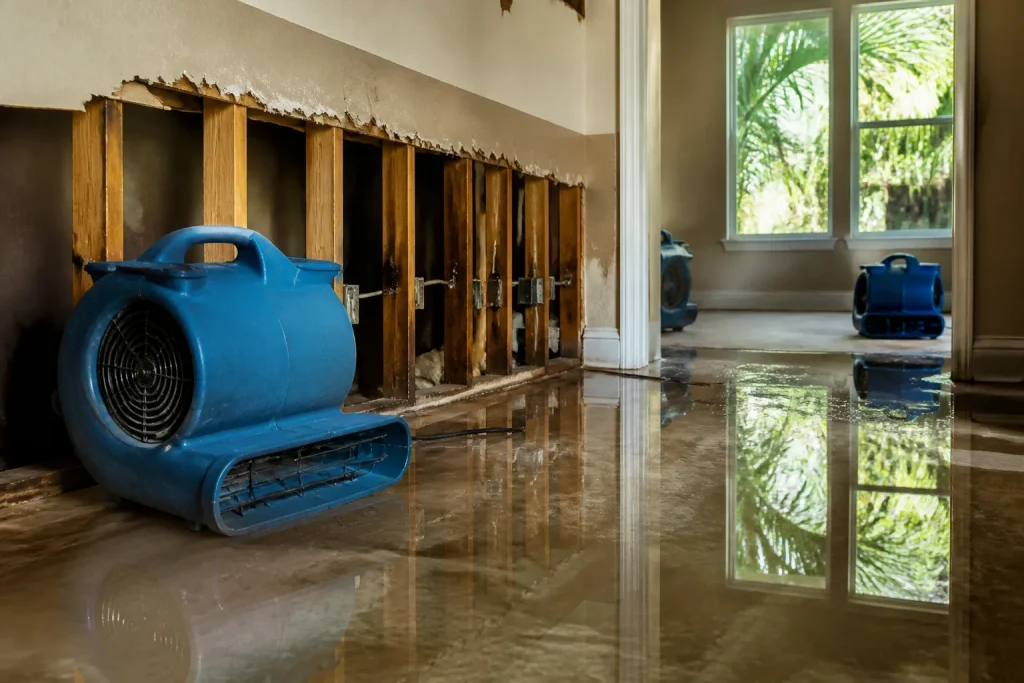
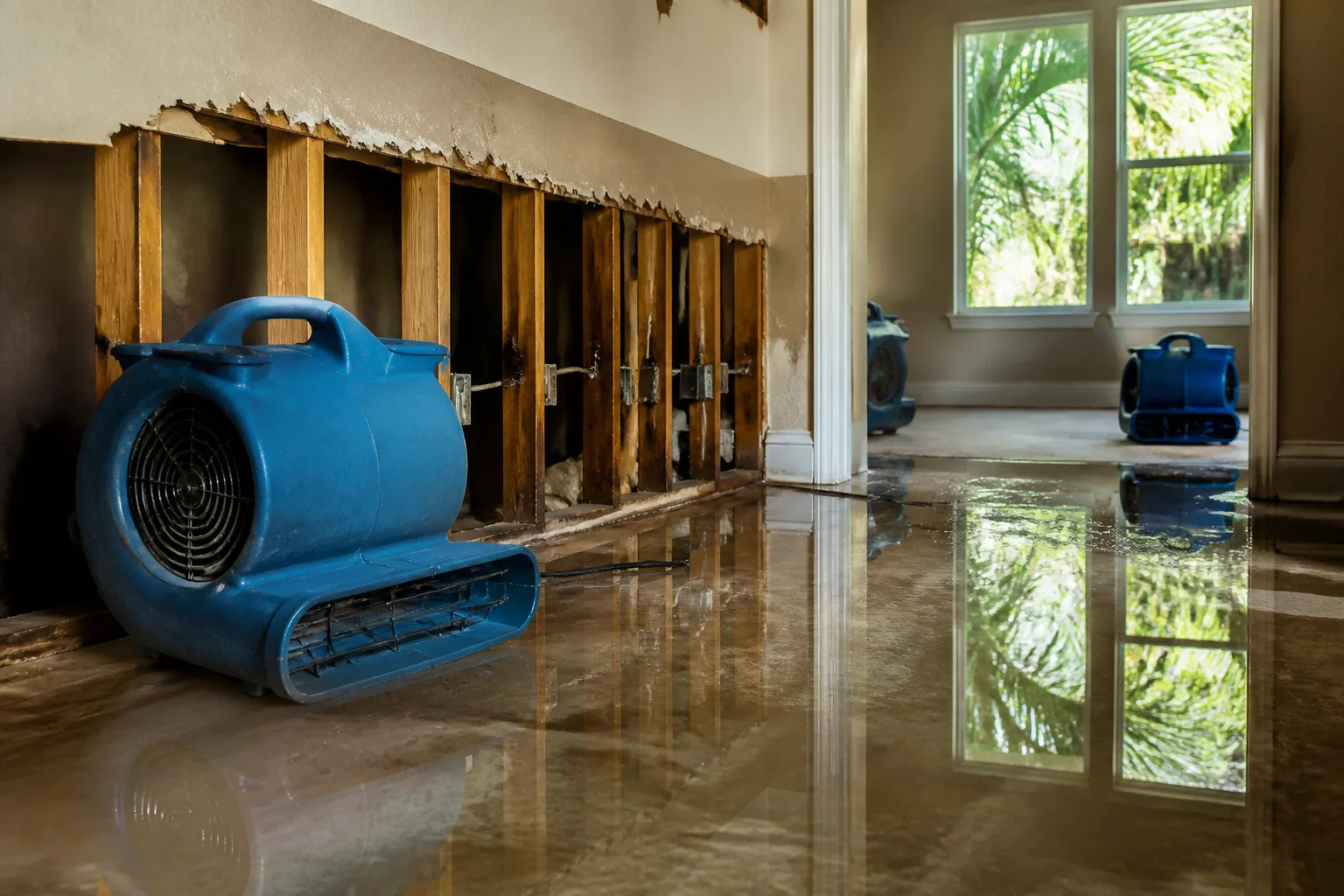
The right sequence, per IICRC protocol, is extraction first, then controlled airflow. A restorer uses truck-mounted or portable extraction equipment to remove standing water, then deploys professional air movers (we use Dri-Eaz and Phoenix units) positioned for directed airflow, plus dehumidifiers to pull moisture from the air. Only then does air movement help. Before extraction, it hurts.
If you catch a leak early and want to do anything productive before a pro arrives, remove items from the wet area, move furniture onto blocks, and document everything with your phone. Leave the fans off until the bulk water is gone.
Mistake 2: Waiting to document the damage
The best photographic evidence of water damage exists within roughly the first 48 hours. Water is visible, water lines on drywall are crisp, swollen baseboards have just started to separate, and stains haven’t yet dried into faint rings. Every hour you wait, the visual evidence gets harder to prove. Adjusters know this. Defense attorneys for insurance companies know this. And frankly, the drywall doesn’t care either way, but your claim does.
What to photograph matters as much as when. A wide shot of the damaged room tells an adjuster almost nothing. You need specific angles and details. Here’s what actually gets claims approved:
- Wide shots from multiple angles that show the room in context, so an adjuster can see exactly where the water traveled.
- Close-ups of the water source, the point of entry, and the water line on walls.
- Macro shots of baseboard separation, bubbling paint, swollen door frames, and any visible mold.
- Photographs of personal property before you move it, including serial numbers on electronics and appliances.
- A photo of the space under sinks, behind toilets, and inside cabinets.
Take more photos than you think you need. Storage is free. Also photograph any receipts for emergency purchases, and log the date and time you first noticed the water. If you eventually file a claim, every photo becomes a data point in proving your loss. Wendell’s technicians document every job with before-and-after photos as a standard part of Water Damage Restoration in Los Angeles, so the visual record is never in dispute. But the window before we arrive belongs to you. Use it.
Mistake 3: Signing a blank or vague authorization form
When water is spreading at 2 a.m. and a restoration company says they can have a crew out in an hour, the last thing anyone wants is a contract review. Scammers and low-quality companies no, the word is companies that underwrite bad behavior with legal paperwork know this. A blank work authorization, or one that authorizes “restoration services as needed” with no scope, no price, and no payment terms, is a blank check.
A legitimate restoration authorization should include at least the following before you sign:
- A written scope of work that specifies extraction, demolition, drying, and monitoring in plain language.
- A line-item price or a clearly defined unit pricing structure, not an open-ended “as needed” clause.
- Payment terms, including any deposit, and when final payment is due.
- A statement that you may receive a copy of the signed document.
- Contact information for a specific project manager who answers questions.
This is not unreasonable. Wendell’s standard practice is to put the price in writing before any work starts, with a digital invoice texted so the number on the screen is the number you pay. That’s the Wendell Water Damage Restoration home standard, and it applies to every job from a toilet overflow in Echo Park to a full main-line break in Brentwood. The takeaway: read before you sign. If the document is vague, ask for specifics. If specifics don’t come, call someone else. The water can wait 15 minutes for you to avoid a six-month billing dispute.
Mistake 4: Calling your insurance company before stopping the water source
This one feels counterintuitive, because every instinct says call the insurance company immediately. And you should call them. Eventually. But not first. First, stop the water.
Here’s why. Every homeowner’s insurance policy contains an implied duty to mitigate damages. That means you are expected to take reasonable steps to prevent the damage from getting worse. An adjuster who hears “I called you first, then spent 45 minutes trying to find the main shutoff valve” is hearing a story where the homeowner allowed a leak to run for an additional 45 minutes. In a worst-case scenario, the insurer can argue a failure to mitigate, and reduce or deny the loss that occurred after the reasonable opportunity to stop the water.
The correct sequence: shut off the water to the affected fixture or the whole house, turn off electricity in the affected area if water is near outlets or wiring, move valuables and electronics if it’s safe, then call your insurance company. A 10-minute delay in reporting the claim costs you nothing. Forty-five minutes of additional water flowing into your subfloor costs you real money, and it becomes the insurance company’s favorite talking point.
This is why Wendell recommends that every adult in a Los Angeles household know where the main water shutoff valve is. In an older house in Silver Lake or a mid-century in the Valley, the valve might be in the garage, buried in a planter, or in a crawlspace. Find it before you need it. If a pipe bursts at midnight, the person who knows where the shutoff is has saved the claim before the claim exists.
Mistake 5: Choosing the cheapest estimate without comparing scope
Restoration estimates in Los Angeles vary. Some of that variation reflects real differences in overhead, equipment, and labor quality. Some of it reflects a different game: the low-ball bid. Those bids look identical at a glance, because they use the same words. Extraction. Dry-out. Monitoring. Antimicrobial treatment. But the words only mean something if the scope behind them is itemized and measurable.
A low-ball restoration bid typically omits several things that get added back after work begins, as change orders. The most common omissions we see:
- Moisture mapping: the process of using moisture meters and thermal imaging to document where water traveled inside walls, ceilings, and floors. Without this, you are guessing.
- Antimicrobial treatment: the application of EPA-registered antimicrobials to prevent mold growth after water damage. Skipping this saves the contractor money and sets up a mold problem 8 weeks later.
- Monitoring visits: the follow-up readings that confirm drying progress and adjust equipment positioning. A one-day dry-out with no monitoring is a gamble, not a process.
- Final moisture verification: proof, with documentation, that the structure reached its dry standard before equipment is removed.
When you compare estimates, compare scopes line by line. Ask each bidder: does this price include moisture mapping, antimicrobial treatment, monitoring visits, and final verification? If the answer is vague, the price is vague too. Wendell’s technicians work under IICRC, RIA, and IFA standards with professional equipment from Dri-Eaz and Phoenix, and the scope includes psychrometric drying, which means we track the air’s moisture level so we know when your home is truly dry, not just surface-dry. That’s a specific, measurable process, and it’s the difference between a low bid and an honest one.
When to Call a Pro
If the water covers more than a few square feet, if it has been standing for more than a few hours, if it came from a sewage line or exterior floodwater, or if you can see water wicking up drywall, call a professional immediately. Water damage restoration is not a jobsite for improvisation. The equipment matters: commercial air movers, refrigerant dehumidifiers, moisture meters, thermal imaging. The standards matter: IICRC, RIA, and IFA protocols exist because untrained drying causes real harm. And the timeline matters: mold begins growing in as little as 24 to 48 hours in warm, wet conditions. Los Angeles summers compress that timeline even further. When in doubt, the cost of a professional is almost always less than the cost of a failed DIY dry-out plus a mold remediation. If you’re in Los Angeles, we offer free estimates. Call (940) 466-4354.
Related services in Los Angeles: Water Damage Repair in Los Angeles and Mold Remediation in Los Angeles.
The Bottom Line
Each of these five mistakes has the same root cause: moving fast without moving carefully. The first 48 hours after a water event in Los Angeles matter more than any other window. Document everything while the evidence is visible. Stop the water before you call anyone else. Read the authorization before you sign. Skip the fans until the water is extracted. Compare scopes, not just prices. And if the scope is bigger than a towel can handle, call a pro who will put the price in writing before any work starts.
If you’re in Los Angeles and you’re dealing with a water event, Wendell Water Damage Restoration offers free estimates. Call (940) 466-4354.
Frequently Asked Questions
How long does water damage take to dry out on its own?
It depends on the size of the affected area, the materials involved, and the airflow, but in a typical Los Angeles home, trapped moisture inside walls and subfloors will not dry on its own without professional intervention. It simply moves. You end up with warped floors, delaminating drywall, and mold inside cavities you can’t see. A professional dry-out, using extraction and controlled airflow under IICRC standards, usually takes 3 to 5 days.
Does homeowners insurance cover water damage restoration?
Most standard HO-3 homeowner policies cover sudden and accidental water damage, such as a burst pipe or an appliance overflow. They typically do not cover gradual leaks, groundwater seepage, or maintenance-related failures. Coverage also depends on whether you took prompt action to mitigate the damage, which is why stopping the water source and documenting everything matters from minute one. Call (940) 466-4354 for an exact review of your situation.
How fast can someone actually get here?
Wendell answers every call with a live person, 24/7, not a voicemail or a callback queue. From there, you get a live arrival time you can track, not a vague four-hour window. In most areas of Los Angeles, a uniformed, background-checked technician can be on site the same day you call.
Do I really need full restoration, or is a deep cleaning enough?
If the water was clean, limited to a small area, caught immediately, and dried within 24 hours, a professional cleaning may be sufficient. If the water was from a washing machine, sewage, exterior flooding, or it sat for more than a few hours, you’re dealing with contaminated water or water that has penetrated building materials, and a deep cleaning will leave moisture and bacteria inside. The safe answer is to have a professional assess with moisture meters. Call (940) 466-4354 for a free estimate.
Written by the team at Wendell Water Damage Restoration.
Need Damage Restoration Help?
Call Wendell Water Damage Restoration - licensed & insured, here with fast after-hours help in Los Angeles.
(940) 466-4354