
Top Signs You Need Damage Restoration Service – Don’t Ignore These
A musty smell in a closet can mean $800 in drywall replacement or $18,000 in full mold remediation – the difference is almost entirely determined by how many weeks you wait to call. The signs of water damage rarely announce themselves loudly. They whisper: a faint smell, a slightly swollen baseboard, a water bill that’s $12 higher than last summer. We’ve worked water damage restoration in Los Angelesand the costliest jobs we walk into are almost never the ones where a pipe burst dramatically. They’re the ones where a slow leak behind a wall ran quietly for months while the homeowner convinced themselves it was nothing. If you’d rather not guess, call us at (940) 466-4354 – we’ll tell you what we think over the phone before anyone schedules a visit.
The Sensory Checklist: What Water Damage Actually Feels, Sounds, and Smells Like
Before you call anyone, run through your home with three senses. Not just eyes. Smell and sound catch what drywall hides.
Smells, ranked by urgency
- Damp earth smell – This is water saturating organic material (wood, drywall paper, carpet pad). It’s the earliest and most common warning. If you notice it in a bathroom or under a sink, you’re likely in the $300 – $900 repair range if you act now. Wait two months and the same smell becomes a $4,000+ mold job. We respond to this exact call pattern weekly all over Los Angeles.
- Musty or “old sock” smell – This means microbial growth is already active. Not necessarily visible mold yet, but the conditions are right. At this stage, mold remediation in Los Angeles typically runs $2,500 – $7,000 depending on square footage.
- Sulfur or rotten egg smell – That’s not water. That’s gas. Leave the house and call your utility company immediately. Do not turn on lights or appliances.
Sounds you should never ignore
- Dripping behind a wall – If you can hear it, water is actively moving. The leak is alive. Find the shutoff valve and call a plumber or restoration crew that day.
- A faint hiss or running-water sound with everything off – You may have a pinhole leak in a supply line inside a wall cavity. Your water meter test (below) will confirm it in under five minutes.
- Floor flex or softness underfoot – Press your heel near tub bases, toilet bases, and the dishwasher. A spongy subfloor means water has been sitting long enough to rot OSB or plywood. Replacement typically starts around $1,200 for a small bathroom section and climbs fast from there.
Visual cues, ranked by how serious the underlying problem is
- Paint bubbling or peeling – Moisture pushing out from behind the surface. Early stage. Usually recoverable without demolition.
- Staining – Yellow, brown, or copper-colored rings on drywall or ceilings. Water has passed through and dried, possibly multiple times. The paper is compromised; expect to cut and patch.
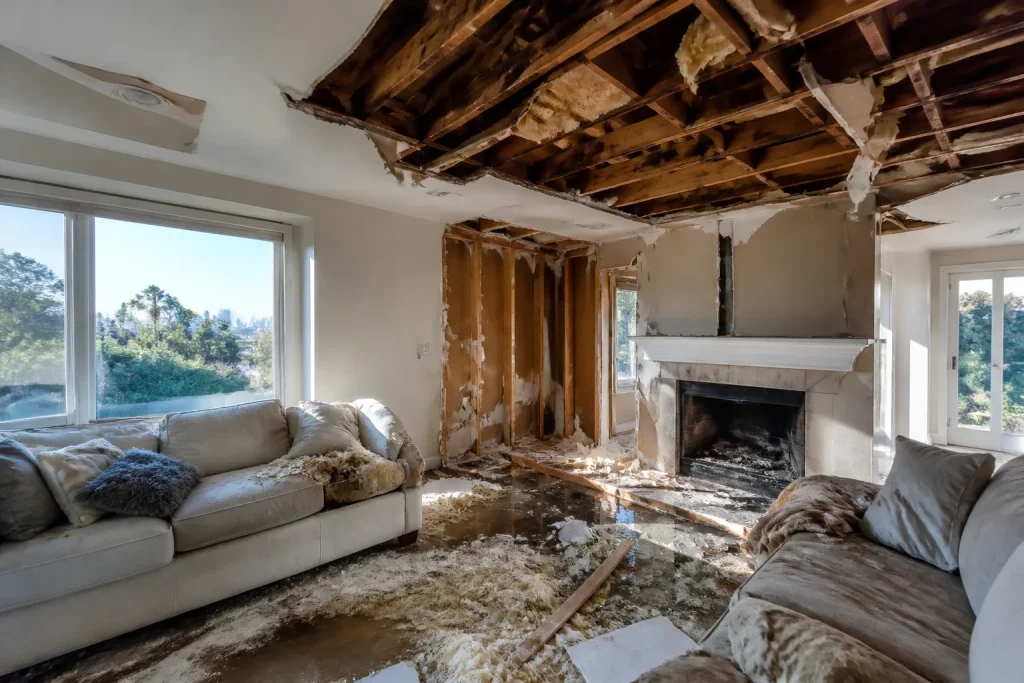
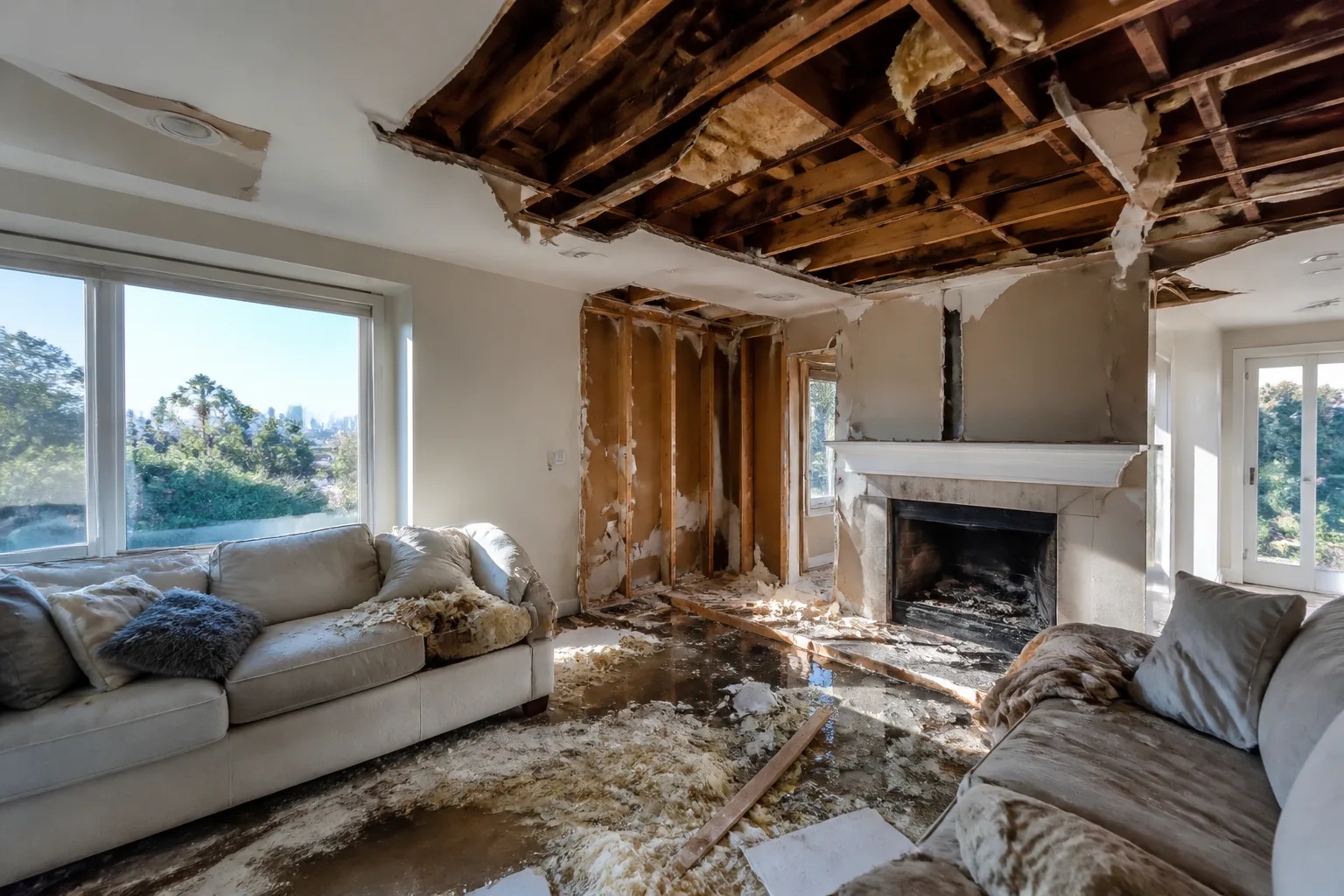
- Sagging or warped drywall – The gypsum is saturated and has lost structural integrity. This is the stage where ceilings in Los Angeles homes start dropping onto furniture without warning.
Why Los Angeles Homes Hide Water Damage Longer Than Anywhere Else
LA’s climate is dry enough that surface materials dry out in a day or two. That’s the trap. The drywall face looks fine, so you assume the problem solved itself. Meanwhile, behind that drywall, moisture in the wall cavity stays at 70 – 90% relative humidity because there’s no airflow in there – perfect conditions for mold that never announce themselves visually.
This is why we use psychrometric drying (tracking the air’s moisture level so we know when your home is truly dry, not just surface-dry). A surface moisture meter reading of 6% doesn’t tell you the stud behind the drywall is at 28%. In Los Angeles specifically, we see this pattern constantly in older homes from the 1920s through the 1970s – plaster-and-lath construction absorbs water differently than modern drywall and can hide saturation for years.
If you live in an older Los Angeles neighborhood like Silver Lake, Echo Park, or West Adams and you’ve noticed a smell for more than two weeks, there’s a real chance the water source is behind the wall, not under the sink. We’ve pulled out lath and plaster in West Adams where the leak had been active for over a year – the only visible sign was a faint smell the homeowner thought was just “old house.”
The Ceiling Stain Shape Test: What Different Stains Tell You
The shape, color, and pattern of a ceiling stain tell you a lot before anyone cuts a hole. Here’s how we read them on a first call.
- Ring stain (a defined circle or outline, often with rings inside rings) – A one-time water release that stopped and dried. Think a tub overflow or a brief roof leak during one storm. The paper surface is stained but the drywall core may be intact. If it’s truly dry and not soft, you may get away with stain-blocking primer and paint. If it’s soft or has been there longer than a month, cut it.
- Spreading stain (edges are fuzzy, no defined border, color varies) – Water is still moving through the material or drying in waves. This is an active moisture event. Something above that ceiling is still wet. In Los Angeles this is most often an AC condensate line, a roof flashing failure, or a plumbing supply line above a second-story bathroom.
- Sagging center (the ceiling visibly bulges downward, often with the stain at the lowest point) – Water is pooling against the drywall from above. That drywall is saturated and could collapse. We recommend you do not stand under it. Use a screwdriver to punch a small hole at the lowest point to drain the water into a bucket if you’re comfortable doing so – otherwise leave it and call a pro. A sagging ceiling in a Los Angeles home is a same-day call.
One wrinkle we see in LA specifically: roof leaks during the January – March rain season often create staining that looks dry by April. The stain fades and shrinks. But the roof decking above it stays wet for months because the Southern California sun warms the attic and traps moisture against the underside of the sheathing. If you saw a stain appear during the rains and it “went away” on its own, you’re not out of the woods – you’re exactly the homeowner we hear from in July when the smell starts.
The 5-Minute Water Meter Test You Can Do Yourself
This is the single most useful thing you can do before calling anyone. It tells you whether you have a hidden leak anywhere in your home’s supply plumbing – the kind that runs behind walls and under slabs, invisible and silent.
Step 1: Turn off every water source in the house. No sinks running, no dishwasher, no irrigation, no ice maker mid-cycle. If your water heater is actively filling, wait until it stops.
Step 2: Find your water meter. In Los Angeles, most meters are in a concrete box near the street or sidewalk, usually marked “WATER.” The lid lifts off or has a small access hole.
Step 3: Write down the meter reading to the last digit, or take a clear photo on your phone.
Step 4: Wait 15 minutes. Don’t use any water during this window.
Step 5: Read the meter again. Any movement = a leak somewhere between the street and your fixtures. Small movement = small leak, large movement = large leak.
If the meter moved, you don’t necessarily know where the leak is – but you know it’s real and you know it’s worth a professional leak detection. Most Los Angeles homeowners we talk to have never run this test. It’s the closest thing to a free diagnostic you’ll ever get.
The Cost Curve: What Waiting Actually Costs
The numbers below are based on what we see across Los Angeles on real jobs, accounting for local labor rates and the older housing stock that makes up much of the city. These are honest ranges, not worst-case scare numbers.
- Week 1 – Visible leak, wet drywall, no mold yet: Water extraction, targeted drying, drywall patch, repaint: $800 – $2,500. Most insurance deductibles are higher than this, so it’s often a self-pay job. Our advice: handle it before it becomes a claim.
- Month 1 – Hidden leak found via smell or water bill, some staining, early microbial growth: Cut out affected drywall, treat framing with antimicrobial, dry in place, patch: $3,500 – $8,000. If mold is visible on surfaces, water damage repair in Los Angeles often pairs with mold remediation and the combined range climbs accordingly.
- Month 3 – Widespread saturation, visible mold, structural damage to studs or subfloor: Full containment, remediation, carpentry, rebuild, finish work: $12,000 – $25,000. At this scale, insurance usually gets involved, and having photo documentation from day one matters enormously.
The same leak, found in week one and handled in week one, is a $1,200 inconvenience. Found in month three, it’s a $18,000 remediation and rebuild that displaces your family for ten days. In our experience across Los Angeles, the most expensive word in residential contracting is “wait.”
When to call a pro: if the smell has lasted more than a week, if the stain is spreading, if you have a sagging ceiling, if your water meter test shows movement you can’t trace, or if anyone in the house has respiratory symptoms that improve away from home – call. Not tomorrow, not after the next rain. This is not a DIY category. Water inside wall cavities behaves according to physics you can’t see, and by the time the damage is visible, the invisible part is four times bigger.
Related reading: Wendell Water Damage Restoration home has our full service range, and our Water Damage Restoration in Los Angeles page covers how our process works from the first phone call to the final photo.
The Bottom Line
Water damage in Los Angeles homes hides better than anywhere else in the country because the dry air masks it. The signs are there if you know how to read them: that damp-earth smell under the sink, a soft spot in the bathroom floor, a ceiling stain that spread from the size of a quarter to the size of a dinner plate. Ignore them and a $900 repair becomes a $9,000 remediation. Run the water meter test. Trust your nose. If any of what you just read sounds like something in your house, make the call before the calendar does it for you.
If you’re in Los Angeles and you’ve been living with a smell, a stain, or a nagging feeling that something is wrong behind a wall, Wendell Water Damage Restoration offers free estimates and we answer the phone 24/7 with a real person. Call (940) 466-4354 and describe what you’re seeing. We’ll tell you honestly whether it’s worth a visit.
Frequently Asked Questions
Run the five-minute water meter test described above: turn off all water, record the meter reading, wait 15 minutes, and read it again. Any movement means you have a leak somewhere. Other signs include a musty smell you can’t source, cracking or bubbling paint, soft drywall, or a floor that flexes underfoot. Call (940) 466-4354 and we’ll help you interpret what you’re seeing.
Early water damage smells like damp earth – that smell you get when you dig into moist soil. As it progresses, it shifts to a musty, stale smell often compared to an old sock or a basement that never gets aired out. If the smell is strong in a closet, under a sink, or near an exterior wall, water is almost certainly saturating building material. Don’t mask it with air freshener – the smell is the symptom, not the problem.
Most Los Angeles water damage jobs fall between $800 and $25,000 depending on how long the water has been present and what it has saturated. Week-one surface drying and patching runs $800 – $2,500. Month-old hidden damage with mold typically runs $3,500 – $8,000. Three months or more of saturation can push past $12,000 when framing, subfloor, or remediation are involved. Call (940) 466-4354 for a written estimate based on what you’re experiencing – the number we quote is the number you pay.
It depends on the source of the water and how long it has been ongoing. Sudden and accidental events like a burst pipe or an overflowing washing machine are typically covered. Long-term leaks, seepage, and flood damage from outside sources usually are not. We work directly with adjusters and provide photo documentation from the initial assessment through the final invoice. If you’re unsure whether to file a claim, call us and we’ll help you think through it before you call your carrier.
Written by the team at Wendell Water Damage Restoration.
Need Damage Restoration Help?
Call Wendell Water Damage Restoration - licensed & insured, here with fast after-hours help in Los Angeles.
(940) 466-4354