
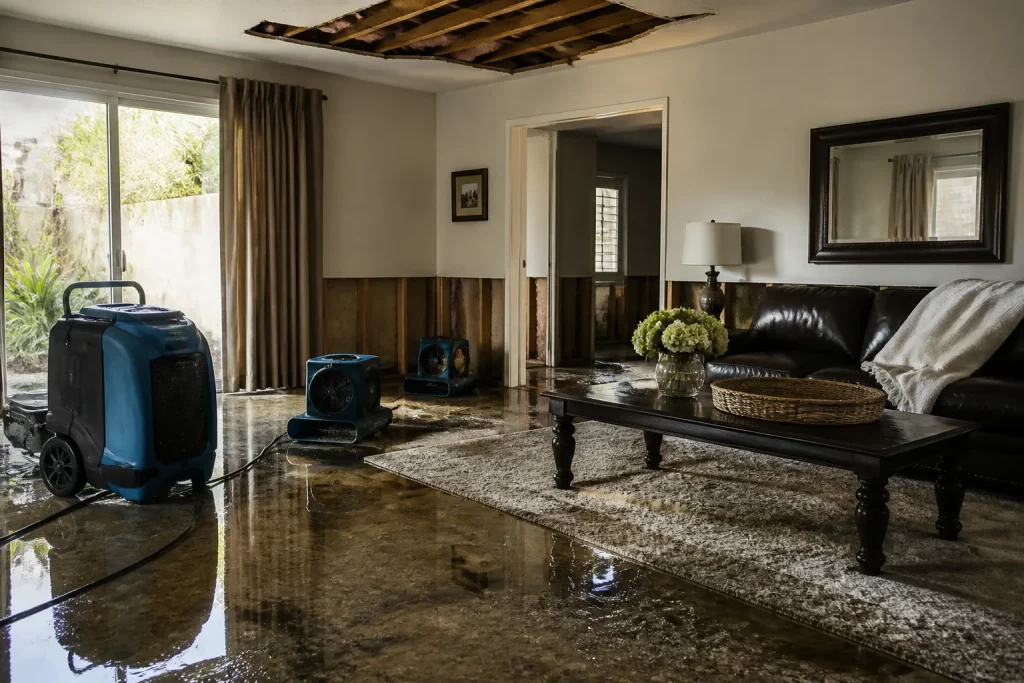
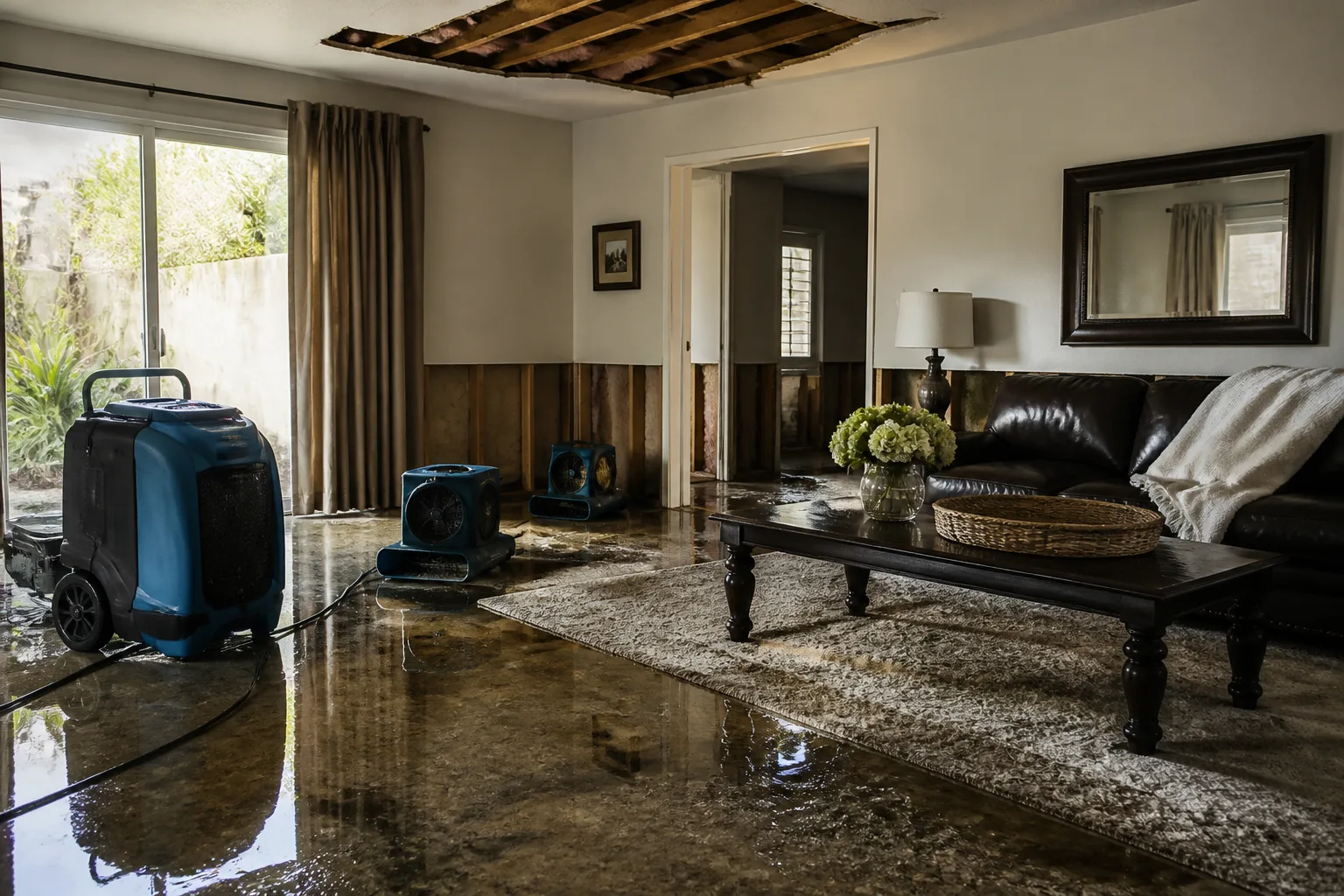
Emergency Water Damage Restoration Near Me: What Los Angeles Homeowners Should Do First
If water is pouring into your Los Angeles home right now, the single most important move is shutting off the main water valve. That valve is almost always outside near the street curb or along the perimeter of the house. The second move is keeping yourself out of standing water that might be touching electrical outlets, appliances, or anything still plugged in. After those two things, call us at (940) 466-4354 and a live person will tell you the next step. If you’d rather not handle any of it yourself, we’ll walk you through it on the phone while a tech heads your way.
Why The First 30 Minutes Matter More Than Any Other Half Hour
FEMA data says secondary water damage, meaning mold growth and the start of structural rot, can begin within 24 to 48 hours after water sits on porous materials. But most Los Angeles homeowners we talk to spend that first hour doing things in the wrong order. They photograph everything for an insurance claim. They post a video of their kid’s bedroom soaked through. They call a family member to ask what to do. All of that can wait. Water doesn’t care about your camera roll. Every minute that water saturates drywall, baseboards, and subfloor, the more material has to come out later.
Here’s a clock-based sequence, not a suggestion list. This is what actually slows the damage:
- Minutes 0 – 5: Shut off the main water valve. In Los Angeles, if you have a pre-1980 home with galvanized pipes, the shutoff valve may be rusted or stiff. Use a pipe wrench if you need to, but get it closed.
- Minutes 5 – 10: Check the breaker panel. Water reaching an outlet or a power strip means you flip that circuit off before you step into the room. This is not the time to test your rubber-soled shoes.
- Minutes 10 – 20: Take photos and a short video. Document the water source, the affected rooms, and any personal property in the water. This is for your insurer, and it’s better to have too much than too little.
- Minutes 20 – 30: Make one call to a restoration company. Not three calls. One call to someone who answers and can tell you when a tech will arrive with a real arrival time you can track.
- Minutes 30 – 45: Open windows and doors if the outside air is dry. In Los Angeles, that’s a real advantage most other cities don’t have. Our dry air accelerates surface drying while you wait.
What you should not do is spend that window calling your insurance company first. We’ll get to why below.
The Order You Should Actually Do Things In (And What To Skip)
Here’s the common mistake we see over and over. A homeowner tries to be efficient: they call their insurance agent while the water is still running, then they call a plumber, then they’ll get around to a restoration company. That ordering is wrong.
Calling your insurance company before a restoration company locks in two problems. First, you’ll get a claim number but no action. Second, the adjuster may assign a preferred vendor that isn’t local to your Los Angeles neighborhood, so you’re waiting hours while someone sits in traffic from another corner of the county. In our experience, the fastest path is:
- Stop the water source
- Call a restoration company that can dispatch immediately
- Start your insurance claim while your restoration tech is already en route
Your insurer will need the water source category, the square footage affected, and a description of materials involved. A restoration company that knows what to document gets that information right the first time. If you call us first, we tell you exactly what to say to the adjuster so the claim moves faster. The insurance call can happen while we’re already setting up equipment.
What Los Angeles Housing Stock Changes About Your First Checks
Los Angeles is not one type of house. It’s a patchwork of 1920s bungalows in Highland Park, mid-century single-story homes in the Valley with raised foundations, and newer builds with PEX plumbing that behaves very differently from old galvanized steel. What that means in practice: knowing the age and construction of your home changes which failure points you check first.
Pre-1980 homes in Los Angeles often still have galvanized supply lines. These corrode from the inside and fail slowly, then suddenly. A pinhole leak behind a wall can saturate the studs for weeks before it shows up as paint bubbling or a musty smell. By the time you see water, the drying job is bigger. Raised foundations also mean water from a burst pipe runs under the floor and sits in the crawlspace, which is exactly the environment where black water contaminants and mold start to thrive. In those homes, we recommend pulling up a corner of the carpet or checking a crawlspace access before you assume the damage is only what you can see.
Newer Los Angeles homes with PEX piping are less likely to burst from corrosion, but water heater failures happen regardless of construction year. And in Los Angeles, the water heater is often in the garage, mudroom, or a closet near the kitchen. That’s worth knowing because a water heater blowout sends 40 to 50 gallons across your floor in minutes. Your first action is the same: shut down the main valve. But the second check should be whether the garage or utility closet drain is clear and if the water is running toward any interior walls.
What To Tell The Dispatcher So The Right Equipment Arrives The First Time
This is the question almost nobody knows to ask. When you call a restoration company, you’re not just asking for someone to show up. You’re giving them enough information to dispatch the correct truck, the correct crew size, and the correct equipment configuration. If you describe the problem as “there’s water everywhere,” you get a generic response. If you describe the water source category, you get the right response.
Water falls into three categories, and you should say which one you have:
- Category 1 (clean water): from a broken supply line, sink overflow, or tub. Safe to touch, but still needs fast extraction.
- Category 2 (gray water): from a washing machine, dishwasher, or aquariums. Contains some contaminants and requires antimicrobial treatment.
- Category 3 (black water): from a sewage backup, rising flood water, or a toilet overflow with waste. This water carries bacteria and pathogens. You want a pro in full protective gear, not someone with a shop vac from Home Depot.
You should also tell the dispatcher how many rooms are affected, whether it’s a slab foundation or raised, and whether the water has reached carpet, hardwood, or drywall. That gives the crew enough info to bring the right amount of Dri-Eaz and Phoenix drying equipment, along with air movers and dehumidifiers sized for the square footage. At Wendell Water Damage Restoration, a live person answers every call 24/7, and that person is trained to ask you these questions so the first truck arrival is the right one.
When To Call A Pro Instead Of Trying To Dry It Yourself
A lot of Los Angeles homeowners think a wet-dry vacuum, some fans, and a sunny weekend will handle a water event. That works sometimes, for a small spill on tile. It does not work for water that has soaked into drywall, under baseboards, or into a crawlspace. Here’s the thing most people don’t know: drywall and subflooring can hold water inside their material layers even when the surface feels dry to the touch.
Proper water damage restoration uses psychrometric drying, which means tracking the air’s relative humidity and moisture content so you know when a material is truly dry, not just surface-dry. We use professional-grade equipment from brands like Dri-Eaz and Phoenix, plus injection drying systems from Injectidry for wall cavities and under hardwood floors. That’s the same equipment profile used on large commercial loss sites. It’s not the same thing as pointing a box fan at a wet patch of carpet and hoping for the best.
If any of these are true, call a pro:
- Water has touched drywall or baseboards for more than an hour
- You can smell an earthy or musty odor
- The water came from a drain line, toilet, or washing machine
- You’re in an older Los Angeles home and suspect water has reached the crawlspace
- The power outlet or wall switch in the room has been touched by water
We pulled a dryer out of a laundry room in Eagle Rock last month where the supply line had been leaking behind the machine for weeks. The homeowner thought it was just a condensation issue. The drywall behind that dryer had turned to a material you could push a finger through. That’s the cost of waiting.
The Written Price And The Guarantee: What Restoration Should Look Like In Los Angeles
Here’s what should happen when you call a restoration company in Los Angeles. The person on the phone should tell you the next available arrival window, and it should be specific, not “sometime between 9 and 4.” The technician should arrive in a uniform and have a background check on file. Before any equipment is unloaded, you should see a written price for the first phase of work, not a verbal estimate that changes at the door.
At Wendell Water Damage Restoration, every job includes a written price before any work starts. We also include a Done Right Promise on every repair: if it’s not done right, we make it right, in writing. And if the repair fails, the second visit is free. That’s unusual in this industry. Most restoration companies in Los Angeles give you a range over the phone and then revise it after they’ve been in the house for an hour. We text a digital invoice so the number on the screen is the number you pay, nothing more.
If you call a company and can’t get a written arrival time, can’t get a written price, or the person answering can’t describe what equipment they’ll bring, hang up. That’s not rudeness. That’s protecting your home and your money. We say this from experience: the good companies in Los Angeles, the ones that survive word-of-mouth in this market, operate with exactly the transparency we’ve described here. The Relay Standard, the process that governs how every independent Relay Home Co. location works, exists because homeowners got tired of vague service windows and surprise pricing.
For more detail on what a full restoration project looks like from start to finish, visit our Water Damage Restoration in Los Angeles page or our Wendell Water Damage Restoration home page for an overview of how we work. If you suspect mold has already taken hold, our Mold Remediation in Los Angeles team handles that under the same written-price model. And if the damage is already dried and you need structural repair, our Water Damage Repair in Los Angeles crew can scope that as a separate project.
The Bottom Line
The first 30 minutes after water damage in a Los Angeles home are about decisions, not labor. Shut off the water. Cut power to wet circuits. Document the scene. Call a restoration company that gives you a live answer, a tracked arrival time, and a written price before work starts. Don’t wait on the insurance company to start your claim, don’t try to dry a soaked crawlspace with a floor fan, and don’t assume the surface is dry because it feels dry.
If you’re in Los Angeles and need help right now, Wendell Water Damage Restoration offers free estimates and a live person answers 24/7. Call (940) 466-4354.
Frequently Asked Questions
That depends on the company and the time of day. A restoration company that answers its own phones with a live person can typically dispatch within an hour in most Los Angeles neighborhoods. Ask for a specific arrival time, not a window. If you can track your technician like a rideshare, that’s a good sign the company is organized enough to handle your emergency.
Most standard policies cover sudden and accidental water damage, like a burst pipe or water heater failure. Gradual damage from a long-term leak is often excluded. The best thing you can do is call a restoration company first, document the water source category, and then start your claim with that information in hand. We help Los Angeles homeowners with this every week. Call (940) 466-4354 if you want help with the documentation.
If the water touched drywall, insulation, hardwood, or a crawlspace, fans alone won’t remove enough moisture to prevent mold and structural rot. Psychrometric drying means measuring the moisture inside materials, not just on the surface. You can try to spot-dry a small clean-water spill on tile, but anything larger needs a professional drying setup with dehumidifiers and air movers.
Ideally, you do, with help from your restoration company. A good Los Angeles restoration team will document the damage, write a detailed scope, and give you photos and moisture readings that make the adjuster’s job straightforward. You still talk to your insurer, but you’ll have real documentation instead of a panicked voicemail. That partnership is what moves a claim through faster.
Written by the team at Wendell Water Damage Restoration.
Need Damage Restoration Help?
Call Wendell Water Damage Restoration - licensed & insured, here with fast after-hours help in Los Angeles.
(940) 466-4354