
Water Damage Restoration What It Really Costs: What Los Angeles Homeowners Pay in 2026
In Los Angeles, most homeowners pay between $4,800 and $11,500 for water damage restoration in 2026. The spread is wide because the final number depends on what’s actually in the estimate: extraction labor, daily equipment rental, monitoring visits, antimicrobial treatment, disposal, and drying documentation. Some contractors bundle all of it. Others leave line items out and bill for them later. If you’re staring at a soaked floor right now and don’t want to wade through the details, call (940) 466-4354 and we’ll walk you through it.
Key Takeaways
- The average LA water damage restoration job costs $4,800 to $11,500 in 2026, but quotes for the same damage can range from $2,000 to $14,000 depending on what’s included.
- Equipment is billed daily: industrial dehumidifiers and air movers run $150 to $500 per day depending on square footage and drying complexity.
- A quote missing equipment line items, daily monitoring, or documentation fees is a red flag that the work won’t be done to industry standard.
- Water damage category (1, 2, or 3) changes the legal requirements and the price. Category 3 work without PPE, certified disposal, and clearance testing is incomplete work.
- Contractors who bill through Xactimate pricing software use rates insurers recognize, which affects what you pay out of pocket.
The Real Cost Components: What You’re Actually Paying For
A water damage restoration estimate in Los Angeles isn’t one number. It’s a stack of line items, and most homeowners only learn that when the invoice arrives. Here’s what’s in a legitimate 2026 estimate, with the ranges we see across LA neighborhoods from the Valley to the Westside:
- Extraction labor: $300 to $800 for the initial water removal. This covers the truck-mounted or portable extraction unit, the technician’s time, and the containment setup if needed.
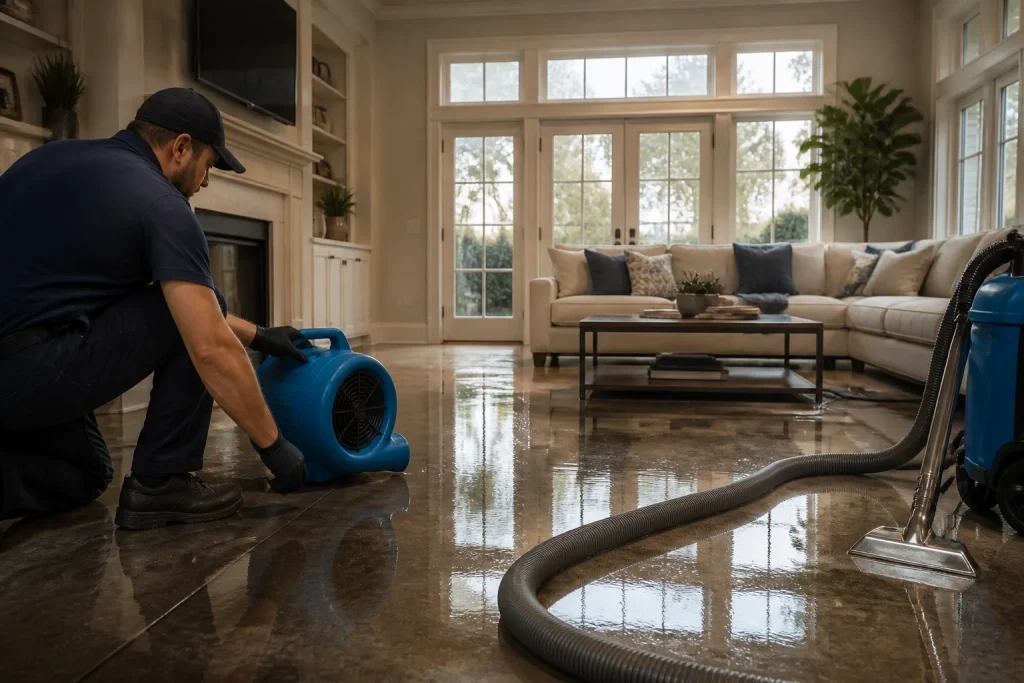
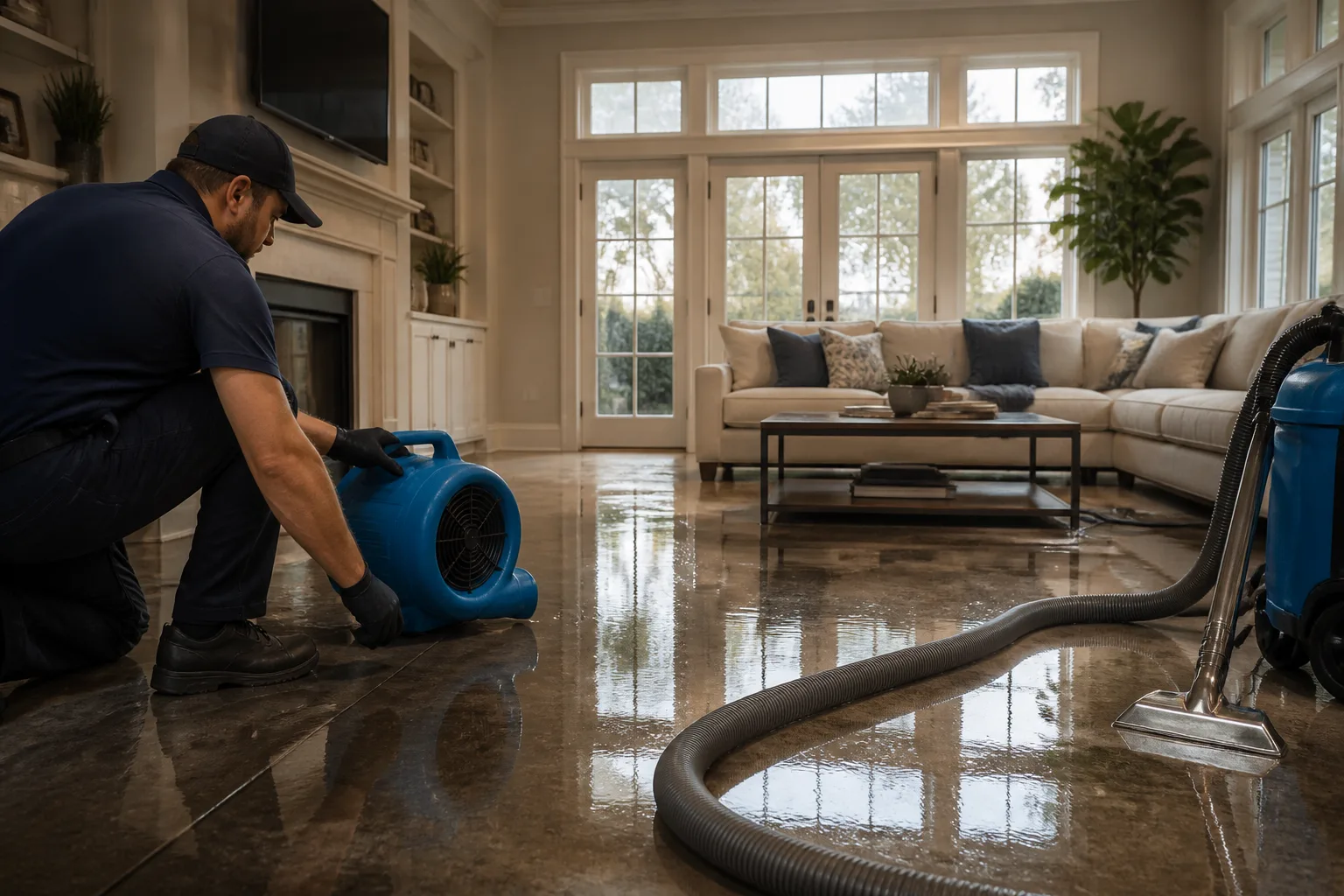
- Drying equipment rental: $150 to $500 per day. Industrial dehumidifiers (like the Dri-Eaz and Phoenix units we run) and air movers pull moisture from drywall, subfloor, and framing. A standard 500-square-foot flood might need 3 to 5 days of equipment runtime. Larger jobs run longer.
- Daily monitoring visits: $75 to $200 per visit. A technician should be visiting every day or every other day to check moisture readings with penetrating and non-penetrating meters. If nobody is checking, nobody knows when the drying actually finished.
- Antimicrobial application: $200 to $600. This is the treatment applied to affected surfaces to prevent mold colonization. It should always be included in any restoration that involved standing water for more than 24 hours.
- Disposal fees: $150 to $600. Soaked drywall, carpet pad, and baseboard cannot be dried and reused in most cases. Removal and certified disposal is a line item, and in LA, dump fees vary by facility.
- Post-drying documentation: $150 to $350. At the end of the job, you should receive a written report showing the moisture readings taken at the start of drying, the readings taken at the end, and confirmation that the structure reached a targeted dryness standard. This is the paper trail you’ll need for insurance and for your own records.
That’s the anatomy of an honest estimate. When we put a price in writing, every one of these line items is on the page before a single dehumidifier turns on. Not after the job. Before it. The number you see is the number you pay, and if anything shifts mid-job, you get a written explanation for every variance before it happens. That’s how we’ve done it at Wendell Water Damage Restoration
Water Categories and Why Category 3 Costs More
Insurance adjusters and IICRC-trained technicians classify water damage into three categories, and the category drives both the price and the legal requirements for the job. In Los Angeles, a quote that ignores the category is a quote for incomplete work.
- Category 1 (clean water): Supply line leaks, sink overflows, or a broken pipe feeding clean water. No special containment or PPE required beyond standard work gloves. Drying and antimicrobial are the main costs. This is the cheapest to restore, typically $2,000 to $5,000 depending on area.
- Category 2 (gray water): Washing machine overflow, dishwasher discharge, or water that’s been sitting for more than 24 hours and developed bacterial growth. Requires containment, more aggressive antimicrobial treatment, and additional PPE. Costs run 30-50% higher than Category 1.
- Category 3 (black water): Sewage backups, rising groundwater, or flood water from outside. This is the expensive one. Full PPE protocols, negative-air containment, certified disposal for all removed porous material, and post-remediation air testing are not optional add-ons. They are required by IICRC protocol standard and by common sense, because the water carries pathogens. A Category 3 restoration in LA commonly runs $8,000 to $20,000 or more depending on square footage.
We pulled a Category 3 job out of a garage up in Granada Hills last year where three other quotes came in under $3,000. None of them included the disposal certification for sewage-contaminated drywall or the post-remediation air test. The homeowner would have paid three grand, had the work done incomplete, and then paid a lot more when mold colonized the framing. That’s the difference between a cheap quote and an honest one. If you see a Category 3 quote that looks too low, check whether the contractor even identified it as Category 3.
How Insurance Billing Works in Los Angeles (and What It Means for Your Wallet)
Most restoration contractors in Los Angeles bill insurance jobs through Xactimate. Xactimate is pricing software that insurers use, and it sets line-item rates per region. When a contractor writes an estimate in Xactimate using the assigned LA price list, the insurer recognizes every price as fair, and payment goes smoothly.
Here’s where homeowners get burned: a contractor who bills outside Xactimate might charge $9,000 for a job that Xactimate prices at $6,500. Your insurer pays what it considers reasonable (the Xactimate number), and the gap between that and the contractor’s invoice becomes your out-of-pocket surprise. That’s not the contractor’s price that changed; it’s that the contractor was never speaking the insurer’s language from the start.
What this means for you: ask any restoration company whether they write their estimates using Xactimate. If the answer is “we don’t use Xactimate,” ask what happens when the insurer pushes back on line-item rates. You want someone who can show the adjuster a standardized, defensible estimate, not a hand-typed number on a letterhead. We write every Los Angeles job in Xactimate, and we’ll also provide the documentation your adjuster needs: photos, moisture logs, and the daily monitoring record. Direct adjuster coordination is part of how we keep the process from becoming a second job for you. If you need help with water damage restoration in Los Angeles, that’s exactly what we do.
Three Pricing Red Flags on LA Water Damage Quotes
A quote is a document. Read it. The same job in Los Angeles can be quoted at $2,000 and $14,000 on the same day, and the difference is almost always in what’s missing, not what’s added. Here are the three things we tell homeowners to check for:
- No equipment line item. If the quote doesn’t include daily rental for dehumidifiers and air movers, the contractor isn’t planning to use proper drying equipment. That means they’re going to extract the standing water, maybe run a box fan from Home Depot, and call it done. Moisture trapped in drywall and subfloor comes back as mold. A quote with no equipment charge is a quote for a sponge and a mop, not restoration.
- No daily monitoring charge. Drying is not a set-it-and-forget-it process. Moisture readings need to be taken every day or every other day, with written records. If there’s no line item for monitoring visits, nobody is tracking the dry down. You’ll have no proof the structure actually dried to a safe level, and your insurance claim will lack the documentation adjusters require.
- No post-drying documentation fee. This is the one homeowners never notice. If the quote doesn’t include a final moisture map and drying report, you’re paying for a job with no written record of what was done. When mold shows up six months later, you have nothing to prove it was the contractor’s scope. Documentation is a line item. It costs money. A quote without it is a quote for work with no accountability.
At Wendell, the written estimate you get before work starts includes equipment, labor, materials, and disposal, plus daily monitoring and the final drying report. We deploy Dri-Eaz and Phoenix dehumidifiers and XPOWER air movers on every job, and we track moisture with penetrating and non-penetrating meters so we know when the structure is dry, not just surface-dry. That’s psychrometric drying: tracking the air’s moisture level so we know when your home is truly dry. It’s standard in commercial loss work, and it should be standard in your living room too.
When to Call a Pro (and When You Can Handle It Yourself)
Some water events are small enough to handle without a restoration company. A supply line pinhole leak caught within minutes, mopped up with the area dried within a few hours, and with no penetration into drywall or flooring, is usually a homeowner job. Dry it, watch it, move on.
But you need a pro when: water has been sitting for more than 24 hours, water has reached drywall or baseboards, the source is a sewage backup or outside flood water, or you can smell anything musty within 48 hours. Those are the conditions where structural drying, antimicrobial treatment, and documentation are non-negotiable. In Los Angeles, where older homes often have plaster and lathe walls that hold moisture differently than modern drywall, a professional moisture meter is the difference between “dry enough” and actual dryness. If you’re unsure, call (940) 466-4354 and describe what happened. We’ll tell you honestly whether it’s a DIY job or a restoration job, and the estimate is free either way.
Related services in Los Angeles: water damage repair in Los Angeles covers the structural restoration after the drying is done, and mold remediation in Los Angeles handles the secondary damage when water sat too long.
The Bottom Line
Water damage restoration pricing in Los Angeles is opaque because contractors choose what to include. A $4,800 job in Boyle Heights and an $11,500 job in Sherman Oaks can be the same amount of water; the difference is whether the quote includes daily equipment, monitoring, antimicrobial treatment, disposal, and the final drying report. Before you accept any number, read the line items. If they’re missing, ask why. If the answer isn’t straight, walk away.
If you’re in Los Angeles and need a straight number, Wendell Water Damage Restoration puts the full itemized estimate in writing before any work begins. No dehumidifier turns on until you’ve seen the price. Call (940) 466-4354 for a free estimate, and we’ll tell you exactly what the job costs and what every line item covers.
Frequently Asked Questions
Most Los Angeles homeowners pay between $4,800 and $11,500 for water damage restoration in 2026. The final cost depends on the water category, square footage affected, how long the water sat, and whether the estimate includes equipment rental, daily monitoring, antimicrobial treatment, disposal, and documentation. Category 1 jobs can run as low as $2,000, while Category 3 sewage jobs commonly exceed $15,000.
It depends on the source. Sudden and accidental events like a burst pipe or a supply line failure are typically covered under standard homeowners policies. Gradual leaks, groundwater flooding, and sewer backup often require separate endorsements or flood insurance. Contractors who write estimates in Xactimate make the claim process smoother because insurers recognize the line-item rates. Call (940) 466-4354 if you want help determining what your policy covers.
Typical restoration takes 3 to 7 days from extraction to final drying documentation. The drying phase depends on the amount of water, the materials affected, and the humidity conditions in the structure. Daily monitoring ensures the job ends when the materials are actually dry, not when the clock runs out. Larger or Category 3 jobs can take 10 to 14 days.
If the water was clean, caught immediately, and didn’t reach walls, flooring, or baseboards, a thorough DIY dry-down can work. If water sat for more than 24 hours, reached building materials, or came from a sewage source, you need professional extraction, structural drying equipment, and antimicrobial treatment. Box fans don’t create the airflow needed to pull moisture from behind drywall. Call (940) 466-4354 for a free assessment if you’re not sure which situation you’re in.
Written by the team at Wendell Water Damage Restoration.
Need Damage Restoration Help?
Call Wendell Water Damage Restoration - licensed & insured, here with fast after-hours help in Los Angeles.
(940) 466-4354