
RIA Water Damage Restoration in Los Angeles: A Homeowner’s Guide
RIA stands for the Restoration Industry Association, the oldest trade group in the damage restoration business, and hiring an RIA-affiliated contractor in Los Angeles means you’re working with a company that follows consensus-based drying standards instead of guesswork. Most LA homeowners have never heard of it, which is a problem because it’s one of the few signals you can actually verify when water is pouring through your ceiling. If you’d rather skip the research and just get someone on the phone, call (940) 466-4354 for a free estimate. Otherwise, here’s what RIA actually means and how to use it as a hiring filter.
Key Takeaways
- RIA is the Restoration Industry Association, founded in 1946, and it sets professional standards for water damage restoration that go beyond basic licensing.
- Fewer than 30 of the 400+ water damage restoration companies in Los Angeles County hold active RIA membership.
- RIA and IICRC are different credentials: RIA is a membership organization with peer accountability, while IICRC is a certification body for individual technicians.
- A contractor following RIA protocols should hand you a moisture log, a drying plan, and a written scope at job completion.
- Proper RIA-standard documentation makes it significantly harder for an insurance adjuster to underpay your claim.
- You can verify a contractor’s RIA status, IICRC certifications, and CSLB license before anyone enters your home.
What Is the Restoration Industry Association, and Why Should a Los Angeles Homeowner Care?
The Restoration Industry Association has been around since 1946. It’s the organization that writes and maintains the consensus-based standards many restoration companies claim to follow, covering everything from how to measure moisture in drywall to when antimicrobial treatment is actually warranted versus when it’s an upsell. But here’s the thing about Los Angeles: there are over 400 water damage restoration companies operating in the county, and fewer than 30 of them hold active RIA membership. That ratio tells you something important about what most restoration contractors consider optional.
RIA membership isn’t a pay-to-play rubber stamp. It requires adherence to the association’s standards, ongoing continuing education, and participation in a peer-accountability structure. That last part matters more than most homeowners realize. When a contractor’s work is subject to review by other restoration professionals, the incentive to cut corners drops fast. We’ve been doing this since 2006, and in our experience, the companies that avoid RIA membership are often the same companies that won’t put a price in writing before they start tearing out baseboards.
One more practical note for LA homeowners: RIA standards exist for a reason in this market. Los Angeles homes run the gamut from 1920s Spanish-style builds with plaster walls to 2020s spec houses with open-cell spray foam, and those materials dry differently. A contractor following RIA protocols knows to adjust the drying plan based on the actual materials present, not a one-size-fits-all playbook.
RIA vs. IICRC: What’s the Difference, and Why Do Contractors Confuse Them?
This is where even smart homeowners in Los Angeles get tangled. Contractors blur these two credentials all the time, sometimes honestly, sometimes because it makes their marketing sound more impressive. Here’s the plain-language breakdown:
RIA (Restoration Industry Association)
- A membership organization for restoration companies, not individuals.
- Companies join and are expected to follow the association’s consensus-based standards.
- Includes continuing education requirements and a peer-accountability framework.
- Think of it as the company-level commitment to doing restoration work the right way.
IICRC (Institute of Inspection, Cleaning and Restoration Certification)
- A certification body for individual technicians and inspectors.
- Technicians earn certifications like Water Damage Restoration Technician (WRT) or Applied Structural Drying (ASD) by completing training and passing exams.
- Think of it as the person-level credential that proves a technician has been trained on current drying science.
Both matter. A restoration company can have RIA membership, but if the technician who shows up at your Los Angeles home has zero IICRC certifications, you’re getting a company-level promise with a person-level question mark. Conversely, a single IICRC-certified tech working for a company with no RIA affiliation and no written-standards commitment is a roll of the dice. When you’re evaluating a contractor, ask for both: company-level RIA or equivalent standards commitment, and individual technician IICRC certifications you can verify. We hold our work to IICRC, RIA, and IFA standards on every job, and our technicians are background-checked and uniformed so you know exactly who is walking through your door.
What an RIA-Standard Drying Job Actually Looks Like in a Los Angeles Home
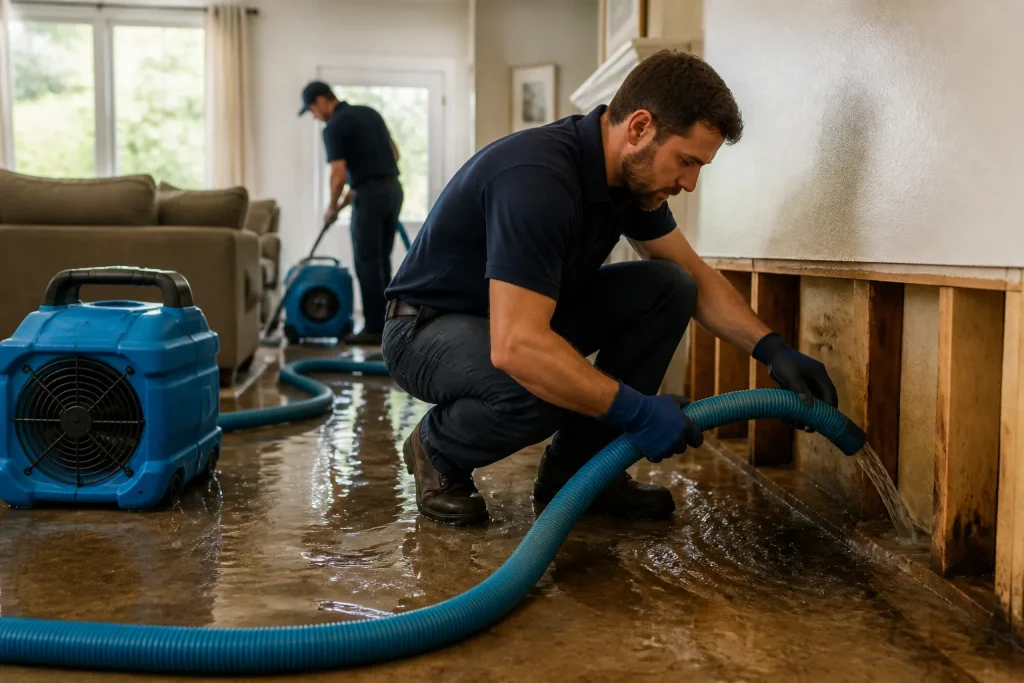
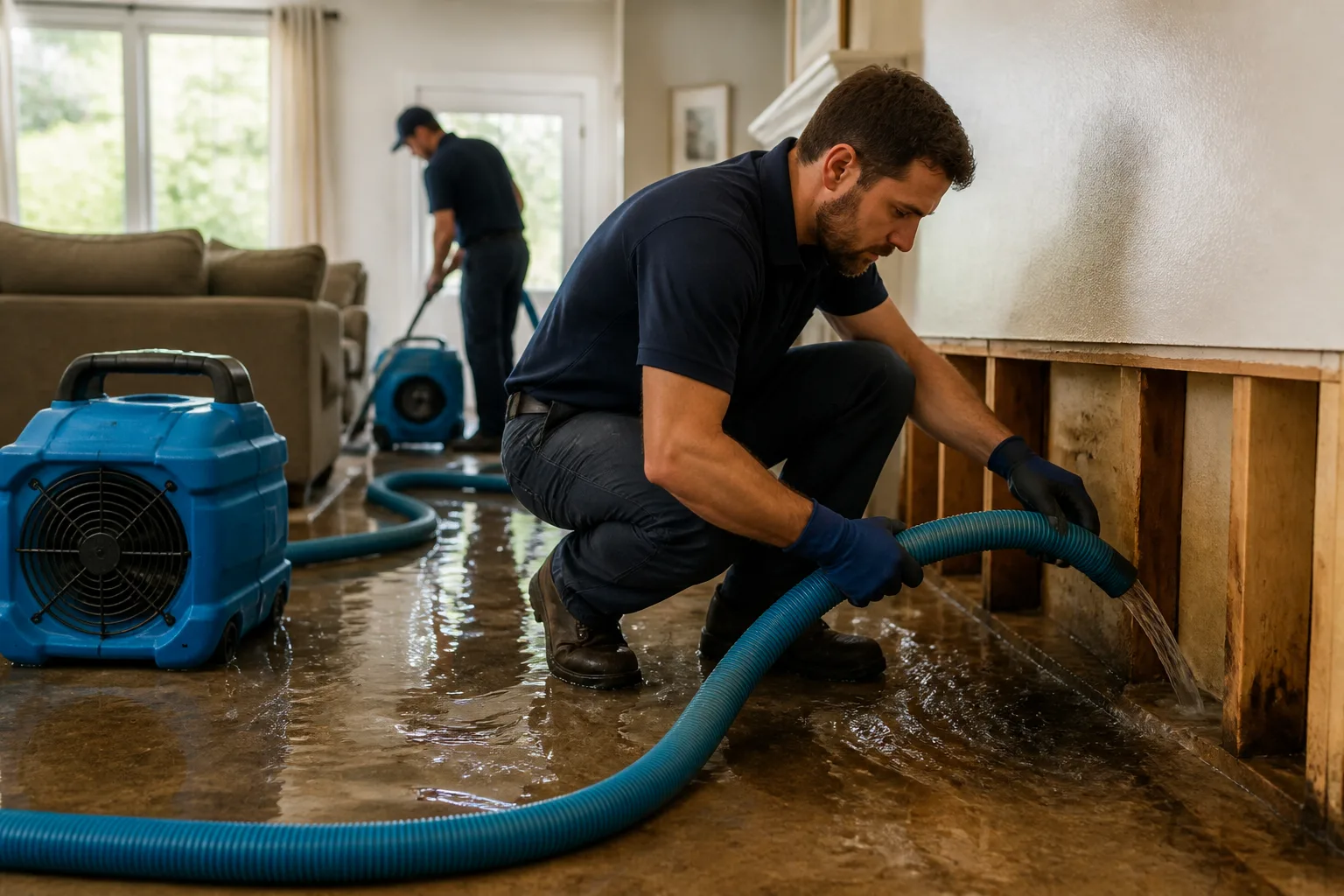
RIA’s standard-of-care language isn’t written for homeowners. It’s written for restoration professionals, and most of it sounds like a physics textbook. Here’s the translation into what you should actually see, receive, and demand from any contractor doing water damage restoration in Los Angeles.
The Moisture Log
A compliant contractor tracks moisture readings in affected materials daily, not just on day one and day done. This means a written log showing readings from affected walls, flooring, and framing taken with a moisture meter at scheduled intervals. In our drying jobs, this log is how we prove the home is actually dry, not just surface-dry. Psychrometric drying means tracking the air’s temperature, humidity, and dew point to calculate the most efficient drying path. If your contractor can’t show you a moisture log, they’re improvising.
When Containment Is Mandatory
RIA standards require containment in specific situations: when demolition creates dust that could spread, when mold is present or suspected, or when drying areas need controlled air pressure to dry faster. In Los Angeles homes, this often means plastic sheeting barriers and negative air pressure machines in affected rooms. If you have water damage in a kitchen and your contractor starts cutting drywall without sealing off the area, they’re creating a secondary problem while solving the first.
Documentation You Should Receive at Job Completion
An RIA-affiliated contractor should hand you a complete documentation package when the job is done. This includes:
- The initial moisture assessment showing what was wet and how wet.
- The daily drying log with moisture readings.
- Photos of the damage, the drying process, and the final condition (before-and-after documentation).
- The final scope of work performed, itemized.
- Equipment logs showing what machines were placed and when they ran.
- Any antimicrobial treatment records, if treatment was necessary.
This documentation matters for two reasons. First, it’s proof the work was done correctly. Second, it’s your insurance claim’s best friend, which we’ll get to next.
RIA Standards and California Insurance Claims: Why Proper Documentation Changes the Math
Here’s a scenario we see regularly in Los Angeles: a homeowner files a water damage claim, an adjuster visits, and the adjuster’s estimate comes in below the contractor’s. The homeowner is stuck in the middle. But here’s the part most people don’t realize: a properly documented restoration job, done per RIA protocols, is significantly harder for an adjuster to underpay. Why? Because the documentation eliminates the adjuster’s primary tool: ambiguity.
California insurance regulations require adjusters to evaluate claims based on the actual documented loss. When your contractor hands you a moisture log showing the drywall was saturated to 95% moisture content, a photo log showing the full extent of the water migration, and an itemized scope with line items matched to standard drying protocols, the adjuster has nowhere to hide. They can’t claim the drying was unnecessary. They can’t claim the demolition was excessive. The documentation is the argument, and it’s already been made.
We pulled one out of a garage over in Silver Lake last month where the homeowner’s insurance company initially denied the drying portion of the claim, arguing the water had “already evaporated.” The moisture readings showed 28% moisture content in the garage framing three days after the leak, which is wet enough to grow mold and rot framing. The log changed the conversation in about ten minutes. That’s what RIA-standard documentation does: it turns a he-said-she-said into a factual record.
One more Los Angeles-specific note: direct insurance billing and photo documentation should be non-negotiable parts of your contractor’s process. A contractor who says, “We’ll sort out the insurance later,” is not your friend. A contractor who says, “Here’s the photo log, here’s the moisture data, and here’s what happened,” is the one you want working on your claim.
The Hiring Checklist: How to Evaluate Any Water Damage Restoration Company in Los Angeles
Enough theory. Here’s the practical checklist to use when you’re standing in an inch of water at 2 a.m. or, better yet, before that ever happens. Los Angeles homeowners should run every candidate through these five filters.
- Verify the CSLB license. The Contractors State License Board maintains a free online database. Any legitimate restoration contractor in California has a CSLB license. Check it before anyone enters your home. If the company name doesn’t match the license, walk away.
- Check RIA or IICRC credentials. Ask for the company’s RIA membership status and the individual technician’s IICRC certifications. A contractor who gets defensive about this question is telling you something.
- Demand a written estimate with scope and timeline before work starts. This is the single biggest differentiator in Los Angeles restoration. A written scope means you know exactly what’s being done, exactly what it costs, and exactly how long it should take. If a contractor hesitates to put it in writing, there’s a reason.
- Identify your point of contact. You need a single person who answers when you call, not a call center rotation. Water damage restoration in Los Angeles is stressful enough without having to explain your situation to a new dispatcher every time you call for an update.
- Ask about documentation and photo updates. Will you receive before-and-after photos by text? Will you get a written moisture log? If the answer to either is no, keep looking.
This is where we have to be honest about how we fit into this framework. Wendell Water Damage Restoration holds work to IICRC, RIA, and IFA standards using professional equipment from Dri-Eaz, Phoenix, XPOWER, B-Air, and Injectidry. But we also add something most LA restoration companies don’t: a written price before any work starts, every time. That’s not an industry norm. It’s a deviation from how most restoration companies in Los Angeles operate, and it’s the entire reason the Relay Visibility Guarantee exists. You get a written price, a live technician arrival time you can track, before-and-after photos by text, and a digital invoice you pay from a link. No vague four-hour windows, no price that changes at the door.
We also back every repair with the 365-Day Done Right Promise in writing: if it’s not done right, we make it right. Plus a free second visit if the repair fails. That’s not a marketing phrase; it’s stated on every job. Related services in Los Angeles include water damage restoration for active water events, mold remediation when water damage has been allowed to sit, and water damage repair for the reconstruction work after drying is complete. If you’re not sure which one applies to your situation, call and we’ll walk you through it.
When to Call a Pro (and When Waiting Costs More)
There’s a simple rule for Los Angeles homeowners: water damage doesn’t get better with time. It gets worse in ways that are invisible for the first few days and expensive for months afterward. Here’s the honest version of what you can handle yourself and what you should never touch.
You can handle: turning off the water source, moving furniture out of standing water, placing towels or a wet/dry vac on small clean-water spills from a known source (a faucet, a supply line you’ve already shut off, a water heater that’s been shut down). You should never attempt: drying inside wall cavities without professional equipment, extracting water from laminate or hardwood floors without assessing the subfloor, or doing any demolition when you can’t see how far the water has actually spread. If the water came from a sewage backup, a toilet overflow, or any grey or black water source, do not attempt any cleanup yourself. That’s a health hazard and needs professional handling with proper antimicrobial treatment.
The threshold for calling a pro is lower than most people think. If water has touched drywall, baseboards, flooring, or any enclosed cavity, call. The equipment alone makes the case: professional drying equipment from manufacturers like Dri-Eaz and Phoenix moves hundreds of cubic feet of air per minute and removes gallons of moisture per day. A box fan and open windows don’t come close. If you’re in Los Angeles and you’re not sure, call (940) 466-4354. It costs you nothing to ask, and the estimate is free.
The Bottom Line
RIA membership is a legitimate filtering signal, but it’s not the whole story. The complete picture is a contractor with company-level standards commitment, individual technician certifications, a CSLB license you’ve verified, and a willingness to put everything in writing before the first tool touches your property. Most of the 400+ water damage restoration companies in Los Angeles County won’t clear all four bars. The fewer than 30 RIA members are a good starting point, but even among those, the written-price-before-work-starts standard is rare. That’s the gap Wendell exists to close. If you’re in Los Angeles and need help, Wendell Water Damage Restoration offers free estimates, written pricing before any work starts, and the 365-Day Done Right Promise on every job. Call (940) 466-4354.
Frequently Asked Questions
RIA stands for the Restoration Industry Association, a trade organization founded in 1946 that sets consensus-based standards for water damage restoration, mold remediation, and related services. Membership requires adherence to those standards, continuing education, and peer accountability. It is different from IICRC certification, which certifies individual technicians rather than companies.
Start with the CSLB license database to confirm the company holds a valid California contractor’s license. Then ask for the company’s RIA membership status and the individual technician’s IICRC certifications. Finally, insist on a written estimate with scope and timeline before any work begins. Companies that resist any of these three verification steps should be eliminated from consideration. Call (940) 466-4354 if you want to skip the homework and talk to a company that meets all three standards.
Yes. A properly documented restoration job, done per RIA protocols, includes daily moisture logs, photo documentation, and an itemized scope of work. This paperwork eliminates the ambiguity adjusters rely on to reduce claim payouts. In California, where insurance regulations require claim evaluation based on documented loss, thorough documentation makes it significantly harder for an adjuster to underpay. Ask any contractor you’re considering whether they provide moisture logs and photo documentation as a standard part of the job.
Shut off the water source if you can identify it and it’s safe to do so. Move furniture and valuables out of standing water. Take photos of everything before you touch anything. Then call a water damage restoration company immediately. Water in wall cavities and under flooring spreads and causes secondary damage within 24 to 48 hours. If you’re in Los Angeles, Wendell answers calls 24/7 with a live person, not a phone tree. Call (940) 466-4354 and you’ll get a written price before any work starts.
Written by Blake Sorensen, Owner at Wendell Water Damage Restoration, serving Los Angeles since 2006.
Need Damage Restoration Help?
Call Wendell Water Damage Restoration - licensed & insured, here with fast after-hours help in Los Angeles.
(940) 466-4354